 Rivulus ottonii, |
History
Distinguished from all other species of the
A. ornatus group by having a unique colour pattern in the caudal fin in males, consisting of dorsal portion of fin white with dark reddish brown spots, contrasting with the ventral portion that is hyaline with dark grey dots and short lines (vs. never a similar colour pattern). Also distinguished from all species of the A. ornatus group, except A. henschelae, by the absence of teeth on the second pharyngobranchial bone (vs. presence); distinguished from A. henschelae by the absence of a longitudinal two of red dots on the ventral part of the flank in males (vs. presence). Also distinguished from all species of the A. ornatus group, except A. ornatus, by having caudal fin pointed in larger specimens (vs. elliptical) and reddish brown spots on the dorsal portion of the caudal fin; also distinguished from A. ornatus by the red pigmentation of ventral portion of caudal peduncle not extending on caudal fin (vs. extending over whole ventral portion of the fin) and dorsal portion of caudal fin white (vs. yellow).
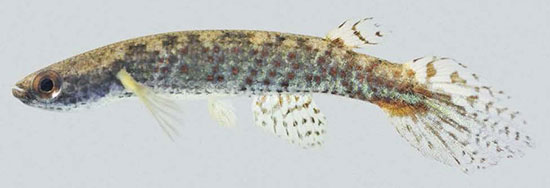
Dorsal profile slightly convex from snout to end of caudal- fin base. Ventral profile approximately straight. Body slender, depressed on head, gradually becoming compressed posteriorly. Greatest body depth at vertical through pelvic- fin base. Jaws short, snout slightly pointed in lateral view. Dorsal and anal fins small, extremity rounded, dorsal ub-rectangular, anal fin sub-triangular. Caudal fin pointed, slender and long. Pectoral fin rounded, posterior margin reaching 90 % of distance between pectoral-fin base and pelvic-fin base. Pelvic fin elliptical, extremity reaching urogenital papilla; pelvic-fin bases medially in close proximity. Dorsal-fin origin posterior to anal-fin base; second proximal radial of dorsal fin between neural spines of 20th and 21st vertebrae, first proximal radial of anal fin between pleural ribs of 14th and 15th vertebrae. Dorsal-fin rays 6 – 7; anal-fin rays 11 – 12; caudal-fin rays 25 – 26; pectoral-fin rays 12 – 13; pelvic-fin rays 7.
Reproduction
No records are available for breeding this species but will not differ from how any other small Rivulus from the Anablepsoides species group reproduce. They are seen as very difficult breeders as they need special attention from the one who keeps the species. In general, keep the water level very low at a max of 10 cm and provide shelter using a thick layer of floating plants and leaves at the bottom. If fed well with small live food like Artemia and mosquito larvae, then collect the fry from the surface or leave them with the parents to grow up
Best to provide them with brownish, soft, and acid water with pH as low as 4,5 to 5,5 pH. Most likely, eggs are produced only in low numbers because they are relatively big (2 mm) for such small fishes.
Remarks :
First of all, live animals are needed for further study on the reproduction and the behavior of this new species.
Variations
Map
Meristics
Literature
Rivulidae) Senckenberg Gesellschaft fur Naturforschung 63(3): 283-293, fig. 6, tab. 5