 Garcialebias botocudo, |
Described in the genus Austrolebias
Abstract original desciption:
Two new species of Austrolebias are described based on specimens collected from temporary pools located in natural grassland landscape within the Araucaria Forest domain at exceptionally high altitudes (~1000 meters a.s.l.). Austrolebias botocudo sp. n. and Austrolebias nubium sp. n. occur, respectively, in drainages of upper rio Apuaê-Inhandava (upper rio Uruguay basin) and upper rio Taquari-Antas (upper rio Jacuí, Laguna dos Patos basin), in the Meridional Plateau of southern Brazil. Despite an intensive survey conducted in the area, only two populations of each species were recorded. Both new species occurs at altitudes that are among the higher recorded for species of the genus, and both are assigned to the subgenus Acrolebias. The new species described herein are easily distinguished for its congeners by the colour pattern of males, by presence of melanophores irregularly distributed in different parts of the body, contact organs cover the body and anal fins, position of fins related with vertebrae, by preopercular and mandibular series of neuromasts united, by a series of morphometric features and by larger maximum standard length. Austrolebias botocudo and A. nubium are distinguished from each other by colour pattern of males, length of contact organs in the flank and number of contact organs in scales of lateral line, dorsal profile of head, number of neuromasts in the preopercular + mandibular series, body depth in females, and by basihyal cartilage length. Additionally, we discuss the conservation status of the new species, and provided an identification key for the species of the subgenus Acrolebias.
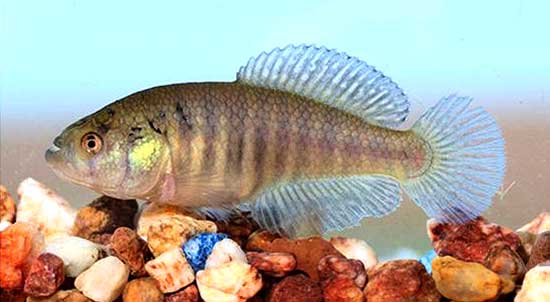
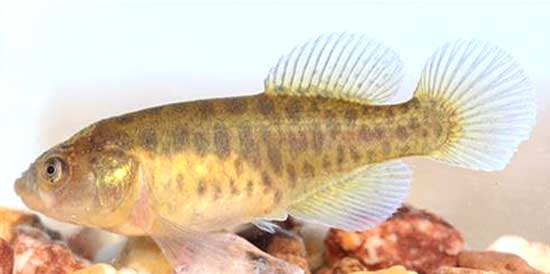
Austrolebias botocudo living colouration (non-preserved specimens) from rio Socorro, rio Upuaê-Inhandava, upper
rio Uruguay basin, Vacaria, Rio Grande do Sul, Brazil.
© Images made and provided by Matheus Volcan.
Holotype. MCP 54450, male, 47.8 mm SL, Brazil, Rio Grande do Sul, Vacaria, temporary pool near rio Socorro, rio Apuaê-Inhandava drainage, upper rio Uruguay basin, 28°22’43.6” S, 50°52’21.8” W, altitude 934 meters a.s.l., L.E.K. Lanés & M.V. Volcan, 26 July 2017.
Garcialebias botocudo (new combination.)
Reproduction in general:
To breed most Austrolebias, you need a tank with about 10 to 25 liter water in it, a small jar or plastic container of about 10 to 15 cm high, a little bit of well-boiled peat moss, or coco-peat, and a water temperature between 18 and 24 C. It is wise to add a small filter to that tank and change the water regularly for 90 %. Bring one male and, if possible, two or more females in the tank and feed the fishes daily with live food like daphnia, red- and black mosquito larvae, and white worms. Austrolebias does not accept dry food quickly, and also, the prepared cow-heart is not preferred if live food is offered. If possible, breed this genus in larger tanks with more than one pair or trio and give some hiding places if you do so. When breeding with more than one male, you should also provide more than one spawning container. Every male must have one, and you will see they show interesting territorial behavior to attract females into their spawning place.
The male "flinders" around the female, displaying his fins high- up with the most intense colors. As the female is willing to spawn, she follows the male, pressing his head towards the layer of peat, and when the female contact the male's belly, both will dive into the peat layer. This layer should have a thickness of at least the length of the largest animal or, better, some deeper so they can dive entirely into it.
The spawning occurs during the whole fertile life of the fishes, starting at 5 to 6 weeks of age, till they become old and weak or die from the lack of water in their natural environment. This "end-of-life" will be within 8 to 11 months, depending on the temperature. Higher temperatures will trigger more rapid aging.
In the wild, Austrolebias live in colder environments during the wintertime. Temperatures in Uruguay, Paraguay, and Argentina can get very low. Incubation time usually is six weeks if stored at high temperatures ( 25 C.) and more extended if kept at lower temperatures. The development can last five to six months also. So it is wise to check the eggs regularly to see if the eyes inside the eggs are fully developed and the iris is well visible. When "eyed-up," put a part of the peat with the eggs in water at cool (ca. 18 C) temperature. If the fry usually hatches- and swims within a few hours, wet the rest of the peat. After hatching, feed the fry immediately with freshly born Artemia nauplii. A day or so later, I pour the water together with the fry off and place them in a well-filtered tank without any peat moss to grow up. Austrolebias are not used to strong currents, and juveniles can die if turbulence is too strong. The remaining peat will still have eggs inside that are not ready to hatch yet. Re-pack the peat and store it for some extra time. This hatching delay is nature's answer to short rain showers that fill pools only temporarily, followed by another dry period. Such an event would kill the entire population of the species in that area if all eggs were hatched with first rains. These (late) eggs will hatch later, sometimes very much later, and the fishes that were born earlier will eat these youngs.
As stated before, young's are growing fast and will produce their first eggs after 5 to 6 weeks already, if not even sooner. This breeding information applies to most Austrolebias. However, if the above Austrolebias- species have different behavior or extreme adult size, find these adaptions below in this chapter under <remarks>.
Remarks;
No data of reproduction on this new species are given, but it is likely they reproduce like most other Austrolebias of medium size.
Variations
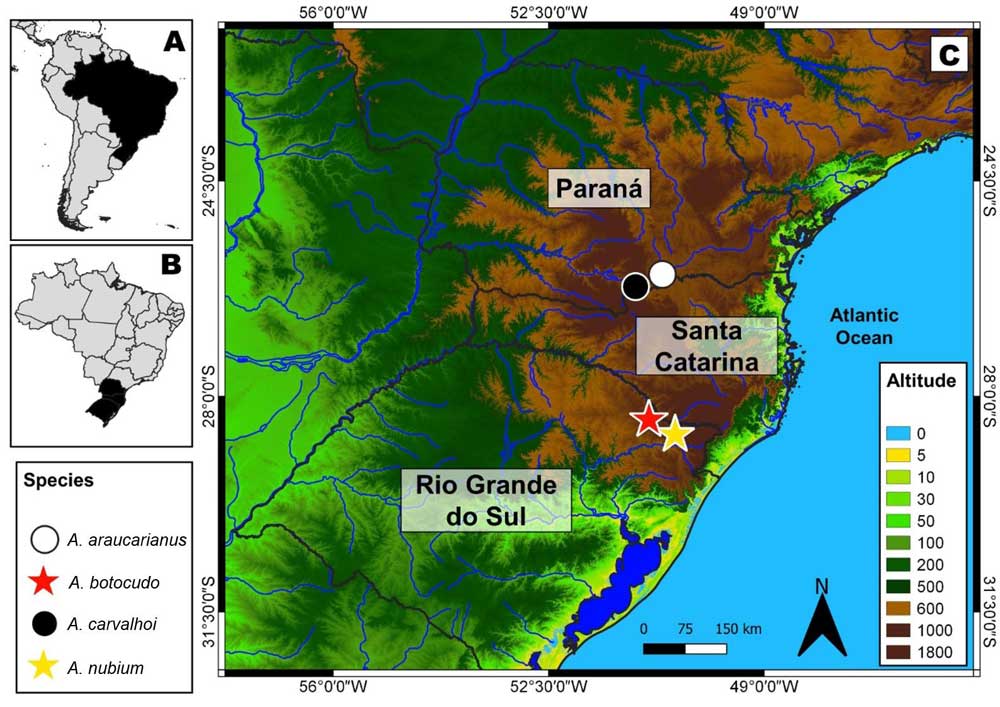
Map
Meristics
Max. size 38.7–55.6 mm in males - female smaller at 28.5–39.3 mm.
Dorsal (average, male only ) 22–24,
Anal (average, male only ) 21–23,
D/A (average, male only ) 3–5,
LL scale count (average) 00.0
Pre- dorsal length to SL – 46.8–57.6 %
Depth to SL – 28.2–36.6 %
Vertebrae count (average) 00.0
Literature
Lanéz L.E.K., M.V. Volcan and L. Matchik 2021. Two new annual fishes (Cyprinodontiformes: Rivulidae) unexpectedly discovered in the highlands of southern Brazil. Zootaxa 4949 (3) 499-520, Fig. 4, Tab. 1.
Alonso F., G.E. Terán, W.S. Serra Alanís, P. Calviño, M.M. Montes, I.D. Carcía, J.A. Barneche, A. Almirón, L. Ciotek, P. Giorgis, J. Casciotta, 2023. From the mud to the tree: phylogeny of Austrolebias killifishes, new generic structure and description of a new species (Cyprinodontiformes: Rivulidae) Zool. Journ. of the Linnean Society, XX, 1-30, Fig. 15, Tab. 2.