 Matilebias periodicus, ) Matilebias periodicus, ) |
Described in the genus Austrolebias.
2023, moved to genus Matilebias.
Etymology: periodical (from Latin: periodicus), in reference to the annual life cycle, like the other species of the genus.
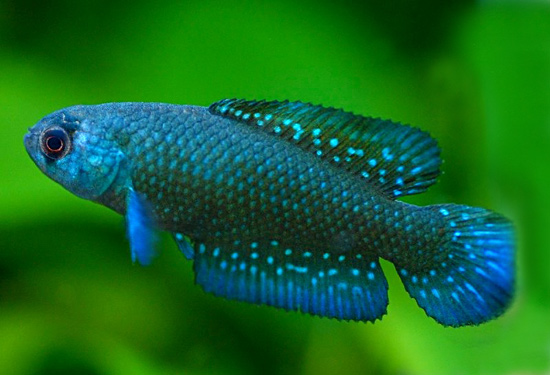
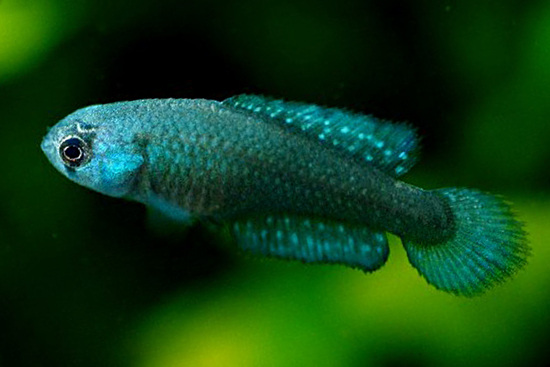
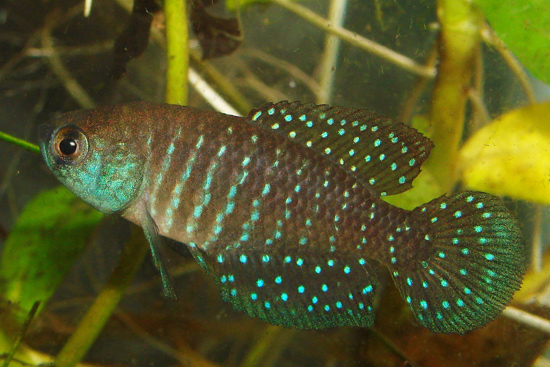
Diagnosis: separated from the related forms by the fully scaled anal and opercular regions, by the straight dorsal profile of head, by the black vertical bars on sides, with light in-between space, blue dotted and gray pectorals in male ; separated from cyaneus by showing less numerous (7-12) vertical bars on male sides (vs. 11-18) ; from cyaneus and affinis by having a positive D/A deviation (versus negative) ; from affinis by male having longer pectoral fins (vs. shorter) ; female with larger blotches on sides (Costa, 1999).
Reproduction
To breed most Austrolebias, you need a tank with about 10 to 25 liter water in it, a small jar or plastic container of about 10 to 15 cm high, a little bit of well-boiled peat moss, or coco-peat, and a water temperature between 18 and 24 C. It is wise to add a small filter to that tank and change the water regularly for 90 %. Bring one male and, if possible, two or more females in the tank and feed the fishes daily with live food like daphnia, red- and black mosquito larvae, and white worms. Austrolebias does not accept dry food quickly, and also, the prepared cow-heart is not preferred if live food is offered. If possible, breed this genus in larger tanks with more than one pair or trio and give some hiding places if you do so. When breeding with more than one male, you should also provide more than one spawning container. Every male must have one, and you will see they show interesting territorial behavior to attract females into their spawning place.
The male "flinders" around the female, displaying his fins high- up with the most intense colors. As the female is willing to spawn, she follows the male, pressing his head towards the layer of peat, and when the female contact the male's belly, both will dive into the peat layer. This layer should have a thickness of at least the length of the largest animal or, better, some deeper so they can dive entirely into it.
The spawning occurs during the whole fertile life of the fishes, starting at 5 to 6 weeks of age, till they become old and weak or die from the lack of water in their natural environment. This "end-of-life" will be within 8 to 11 months, depending on the temperature. Higher temperatures will trigger more rapid aging.
In the wild, Austrolebias live in colder environments during the wintertime. Temperatures in Uruguay, Paraguay, and Argentina can get very low. Incubation time usually is six weeks if stored at high temperatures ( 25 C.) and more extended if kept at lower temperatures. The development can last five to six months also. So it is wise to check the eggs regularly to see if the eyes inside the eggs are fully developed and the iris is well visible. When "eyed-up," put a part of the peat with the eggs in water at cool (ca. 18 C) temperature. If the fry usually hatches- and swims within a few hours, wet the rest of the peat. After hatching, feed the fry immediately with freshly born Artemia nauplii. A day or so later, I pour the water together with the fry off and place them in a well-filtered tank without any peat moss to grow up. Austrolebias are not used to strong currents, and juveniles can die if turbulence is too strong. The remaining peat will still have eggs inside that are not ready to hatch yet. Re-pack the peat and store it for some extra time. This hatching delay is nature's answer to short rain showers that fill pools only temporarily, followed by another dry period. Such an event would kill the entire population of the species in that area if all eggs were hatched with first rains. These (late) eggs will hatch later, sometimes very much later, and the fishes that were born earlier will eat these youngs.
As stated before, young's are growing fast and will produce their first eggs after 5 to 6 weeks already, if not even sooner. This breeding information applies to most Austrolebias. However, if the above Austrolebias- species have different behavior or extreme adult size, find these adaptions below in this chapter under <remarks>.
Remarks;
Variations
Map
Meristics
Dorsal 24.0,
Anal 23.0,
D/A 0.1
LL scale count (average) 26.5
Pre- dorsal length to % SL – 48.7 %
Depth to % SL – 35.8 %
Literature
Coste W.J.E.M. 1999. Cynolebias periodicus, a new annual Fish from the Rio Ibicui drainage, southern Brasil (Cyprinodontiformes: Rivulidae). Ichthyol. Explor. Freshwaters, 10 (4): 299, figs.1-2
Volcan, M.V., L.E.K. Lanés & A.C. Goncalves. 2010. Pisces, Cyprinodontiformes, Rivulidae, Austrolebias periodicus (Costa, 1999): Distribution Extension in state of Rio Grande do Sul, southern Brazil. Check List, 6 (2): 234-236.
Loureiro, M., R. de Sa, Serra S.W., F. Alonso, L.E.K. Lanés, M.V. Volcan, P. Calviño, D.T.B. Nielsen, A. Duarte & G. Garcia. 2018. Review of the family Rivulidae (Cyprinodontiformes, Aplocheiloidei) and a molecular and morphological Phylogeny of the annual fish genus Austrolebias Costa 1998. Neotropical Ichthyology, 16(3),
Alonso F., G.E. Terán, W.S. Serra Alanís, P. Calviño, M.M. Montes, I.D. Carcía, J.A. Barneche, A. Almirón, L. Ciotek, P. Giorgis, J. Casciotta, 2023. From the mud to the tree: phylogeny of Austrolebias killifishes, new generic structure and description of a new species (Cyprinodontiformes: Rivulidae) Zool. Journ. of the Linnean Society, XX, 1-30, Fig. 15, Tab. 2.