 Rivulus beniensis beniensis, |
History
Alternative name Benirivulus beniensis beniensis.
Rivulus beniensis was originally described from material originate from Ivon, at the Rio Beni in Bolivia. The description by Myers in 1927 was based on samples that were brought back by Dr. Carl Ternetz during the famous Mullford expedition that took place between 1921 and 1922. (See below for detailed info).
J.F. Fels and J.H. Huber redescribed the species in 1985 in the same paper in wich they described Rivulus derhami.
The Mulford Expedition of 1921–1922 was organized by Henry Hurd Rusby to explore the Amazon Valley from the headwaters of the Quime River in Bolivia to the mouth of the Amazon in Brazil. The expedition arrived in Bolivia in July 1921 and began collecting high in the Andes, just south of La Paz. Using balsa-wood rafts, they moved down the Bopi River, stopping for weeks at a time to collect in Huacho and Rurrenabaque. In December, Rusby was forced to leave the expedition due to ill health, traveling alone down the river until he was rescued by a government patrol boat. Before he left, he hired Martin Cardenas, then a student, to assist with collecting. White and Cardenas continued collecting in the lowlands of Eastern Bolivia, making extensive collections near Tumupasa, Ixiamas, Lago Rogagua, Ivon, and Cachuela Esperanza.


Known synonymes are Rivulus strigatus Regan 1912.
Related species are Rivulus lacustris and Rivulus bolivianus that share the large occellus at the upper base of the caudal peduncle, a dark lower lip, large eyes and a strated pattern. Rivulus lacustris is also known Rivulus beniensis lacustris.
Remarks;
Reproduction
Keeping and breeding are easy bu,t a tight-fitting cover on the aquarium is necessary because their ability to jump, even through the tiniest opening, is unbelievable.
If there is enough space for them, this species can be housed in a tank with more than one male and several females. If separated before and brought together again, they can be very aggressive towards each other and fight to become the dominant fish. The best way to produce good numbers of fry is to put a pair or a trio in a small tank of about 10 liters with a small filter in it or with some aeration. On the bottom of the tank, place some peat moss or dark gravel and a floating "mop" to give space for laying their eggs. If they are fed a rich variety of live food, the fish will spawn during their whole adult life and produce daily between 5 to 10 eggs.
The eggs should be collected by hand and stored for about 14 days in a small container. Eggs are 1.5 mm and amber-colored. It is wise to add an anti-fungus like Tripavlavine to the water you store the eggs in to prevent fungal attacks.
After hatching, the fry can eat fresh Artemia nauplii without any problem. However, it takes 4 to 5 months to raise them to maturity. Often the males far outnumber females. For some species, this can become a significant problem for the breeder, as he has to raise many fries to enable the distribution of a few pairs to other hobbyists. Recent personal tests found that lower pH levels during hatching gave a higher percentage of females. I used some peat moss that I added to the container with the eggs just before they were ready to hatch to achieve this. This peat moss also is an excellent way to prevent eggs from being attacked by fungus.
Their lifespan can be 2-3 years in captivity.
Remarks :
Was for a long time not present in the hobby but came available again in 2002 as result of a collecting trip by Joachim Thomas et al., Gemany.
Variations
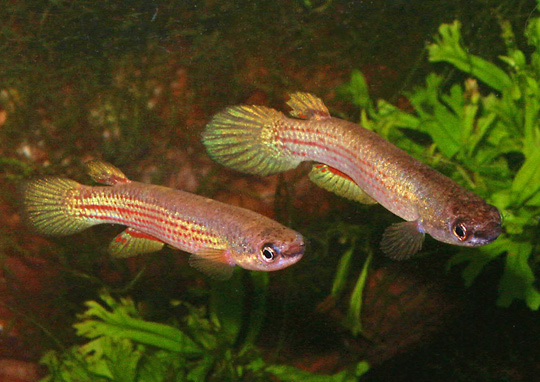
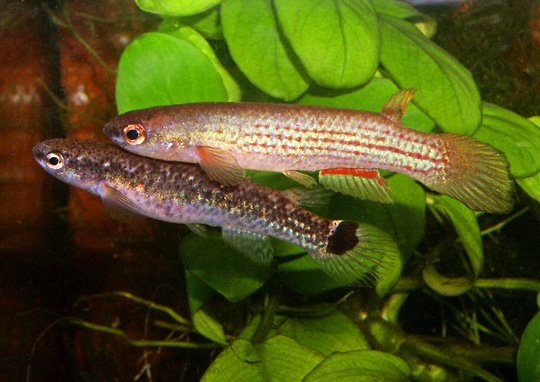
Map
Meristics
Max. size 4.0 cm.
Dorsal 7.0,
Anal 12.0,
D/A 9.0
LL scale count (average)34.0
Pre- dorsal length to % SL – 77.0 %
Depth to % SL – 18.6 %
Literature
Myers, G.S. 1927. Descriptions of new South American Freshwater Fishes collected by Dr. Carl Ternetz. Bull. Mus. Comp. Zool;. Harvard, 68 (3): 133.
Fels, J.F. & J.H. Huber, 1985. Description dúne espèce nouvelle de Rivulus du Pérou, R. derhami n. sp. & nouvelle description de R. beniensis Myers, 1927. Rev. fr. Aquariol., 12, 2: 35-38, fig. 5-7, 2 tab.