 Rivlus boehlkei, |
History
Alternative name Cynodonichthys boehlkei.
Dr. J. H. Huber described this species from museum material he found in the collection of the Philadelphia Museum and named the species after the Curator & President of that Museum, also discoverer of the species, James E. Böhlke. The material was in the museum since its discovery on March 24, 1973 by Böhlke.
J. Huber mentionned the need of new collection as its connection to Rivulus elegans and Rivulus magdalenae is not clear. Based on its distinctive characters in preserved state it may be linked to Rivulus leucurus and/or Rivulus elegans.
During my second expedition to Colombia february 2008, recollecting Rivulus boehlkei was one of the main goals. I made it to the location near the village San Miguel and I could find nice fishes in swift creeks up the Rio la Miel that was raging downwards itself. The creeks were about 27 km UP-stream and situated in very difficult to reach position. It took a spectacular ride in a small boat, half way somebody had to get out and wait on a rock till we would return as the boat would not make it with that person aboard.
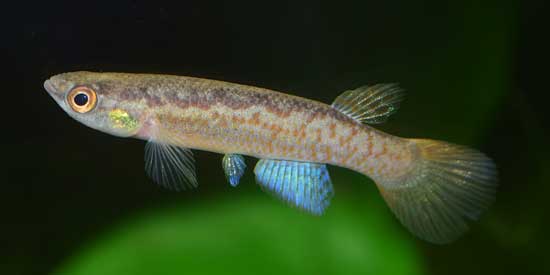
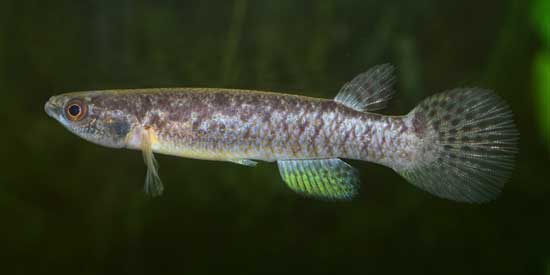
The species we found had lot of resemblance with the Rivulus elegans from its terra typica Caceres, Cauca River, that we rediscovered earlier that trip. The only problem seems the fact that the females I found do not have a caudal ocellus in life state and the description of the female Rivulus boehlkei says "with" caudal ocellus. The species I found is turned out new to science and described as Rivulus ribesrubrum in 2013.
The field notes, explaining the place the species was discovered (5.3 - 12 km. downstream from San Miguel. The village is approximately 12 km from the mouth of the Rio la Miel that flows in the Rio Magdalena and no swift creeks are seen inbetween (only pools with brown standing water without any life fish seen). I need to get a better look for this species there again.
Reproduction
Keeping and breeding is easy but a tight fitting cover on the aquarium is necessary because their ability to jump, even through the smallest opening, is unbelievable.
This species can, if there is enough space for them, be housed in a tank with more than one male and several females. If separated before and brought together again however, they can be very aggressive towards each other and fight to become the dominant fish. The best way to produce numbers of fry is to put a pair or a trio in a small tank of about 10 litres with a small filter in it or with some aeration. On the bottom of the tank place some peat moss or dark gravel and a floating "mop" to give space for laying their eggs. The fish will, if they are fed a rich variety of live food, spawn during their whole adult life and produce daily between 5 to 10 eggs.
The eggs should be collected by hand and stored for about 14 days in a small container. Eggs are 1.5 mm and amber coloured. It is wise to add an anti fungus to the water you store the eggs in, to prevent fungal attacks.
After hatching the young fry can eat fresh artemia nauplii without any problem. It takes 4 to 5 months to raise them to maturity. Often the males far out number females. For some species this can become a major problem for the breeder, as he has to raise many fry to enable distribution of a few pairs to other hobbyists. Recent personal tests found that lower pH levels during the time of hatching gave a higher percentage of females. To achieve this I used some peat moss that I added to the container with the eggs just before they were ready to hatch. This peat moss also is a good way to prevent eggs from being attacked by fungus.
Their lifespan can be up to 2 years in captivity.
Remarks :
Variations
Map
Meristics
Max. size 4.5 cm.
Dorsal 9.0,
Anal 14.0,
D/A 11.0
LL scale count (average)35.0
Pre- dorsal length to % SL – 77.0%
Depth to % SL – 20.1 %
Literature
Huber, J.H. & J.F. Fels. 1985. Un nouveau Rivulus de Colombie, Rivulus boehlkei n. sp. (Pisces, Cyprinodontidae). Cybium, 9 (3): 316, fig.1.