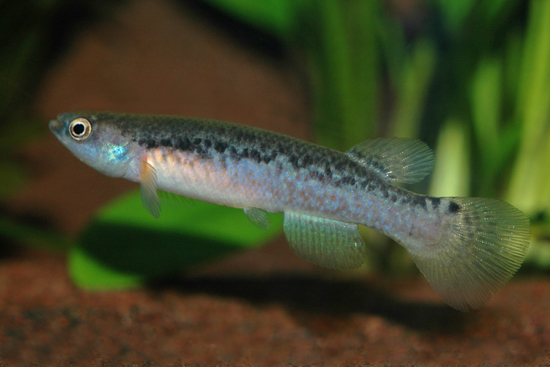
 Rivulus magdalenae, ( Rivulus magdalenae, ( |
History
Alternative name Cynodonichthys magdalenae.
Original type locality is at 1300 meter altitude, near Ibagué, close to the upper rio Magdalena, Colombia,
Type series: FMNH [Chicago] 56997 (ex. CM 5813) (holotype), CAS-SU [San Francisco] 44227 (12) (ex. CM 5814a-m, IU 13603) (paratypes), FMNH [Chicago] 56998-99 (12, 8) (paratypes), FMNH [Chicago] 57000-02 (2, 8, 1) (paratypes), CAS-SU [San Francisco] 52234 (ex. IU 13606) (6) (paratypes), CAS-SU [San Francisco] 52235 (ex. IU 13605) (2) (paratypes), CAS-SU [San Francisco] 78377 (ex. IU 13606) (6) (paratypes)
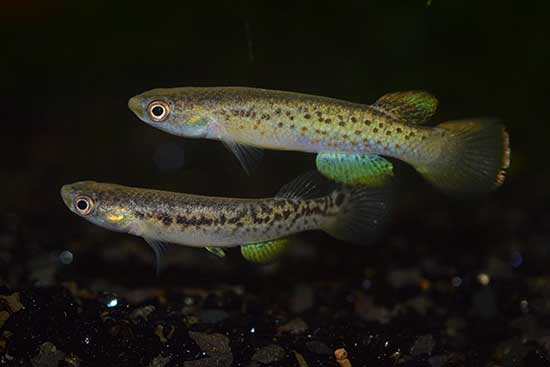
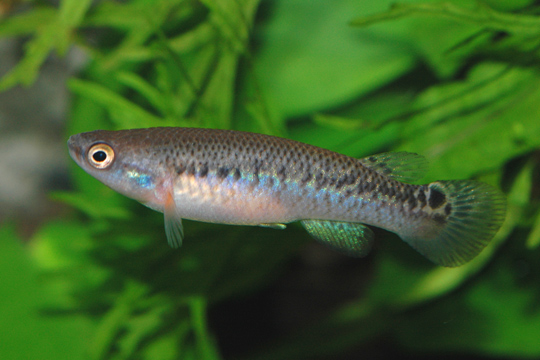
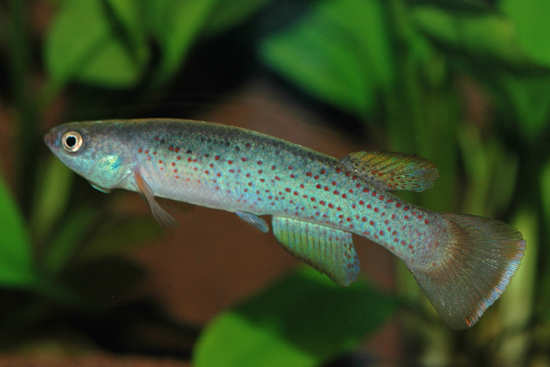
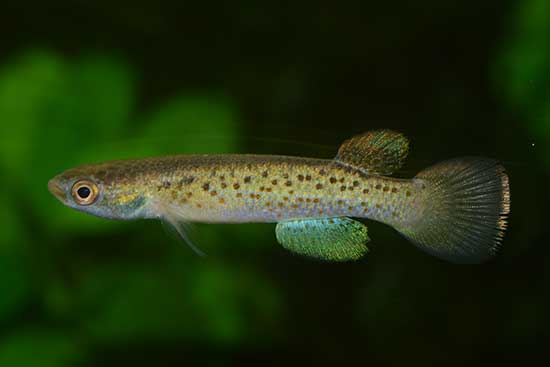
Rivulus magdalenae is one of the Rivulus species that were kept by breeders and aquarists before the worldwar II. I grew up with the hope to be able once in my life to find the Rivulus magdalenae myself, and when I got the oppertunity to search for Rivulus in Colombia, I grabed it with both hands. I never went to the type Locality itself in Ibagué, but found them in most unlikely places like places along swift streams, in somebody's back yard in Santandercito and recently in a sulphate river north of Tocaima in the departement of Cundinamarca. All whitin a radius of less than 100 km.
The species has a large spreading and is primarily living in streams with reasonable flow. They are strong swimmers and can get hold between rocks and debris like wood.
Reproduction
Keeping and breeding are easy, but a good cover of the aquarium is necessary because their ability to jump, even through the tiniest opening, is unbelievable. If there is enough space for them, this species can be housed in a tank with more males than one only and several females. If separated before and brought together again, however, they can be very aggressive to each other and fight to become dominant to others. An excellent way to get offspring is to put a pair or a trio in a small tank from 10 liters with a small filter in it or with some aeration. Some peat moss or dark gravel and a floating "mop" to give space for laying their eggs on the bottom. If they become a wide variety of life food, they will spawn during their adult lives and produce daily between 5 to 15 eggs. The eggs should be collected by hand and stored for about 14 days in a small container. Eggs are 1.6 mm and amber-colored. It is wise to add some acriflavine to prevent fungus from coming up. |
After hatching, the young fry can eat fresh artemia nauplii without any problem. It takes 4 to 5 months to raise them to maturity. Often the number of males is far above the number of females. For some species, this can become a significant problem for the breeder as he has to raise many young fishes and so become able to distribute a few pairs to other hobbyists. Recent personal tests learned that lower pH levels during hatching gave a higher percentage of females. To achieve this, I use some peat moss that I add to the container with the eggs just before they are ready to hatch. This peat moss also is an excellent way to prevent eggs from becoming attacked by fungus.
Their lifespan can be up to 3 years in captivity.
Remarks :
Variations
Map
Meristics
Max. size 9.0 cm.
Dorsal 10.1,
Anal 16.0,
D/A 10.1,
LL scale count (average)39.0
Pre- dorsal length to % SL – 74.0 %
Depth to % SL – 19.0 %
Literature
Henn, A.W. 1916. On various South American Poeciliid Fishes. Ann. Carnegie Mus., 10 (9): 109.