 Cynolebias gorutuba, Cynolebias gorutuba, |
History
Two new species of Cynolebias are described from temporary pools of the Verde Grande River drainage, São Francisco basin, in the semiarid Caatinga, a phytogeographical prov- ince of northeastern Brazil. Cynolebias elegans sp. n., a member of the C. gilbertoi group, is considered as the smallest species of the genus, reaching about 38 mm of standard length; it is distinguished from all other species of the group by the long unpaired fins, relative position of anal fin and vertebrae, and morphometric data. Cynolebias gorutuba sp. n. belongs to the Cynolebias zeta-clade, a group of large species supposedly feeding on smaller sympatric seasonal killifishes; it differs from other species of the group by the female colour pattern, relative position of dorsal fin and vertebrae, and cephalic neuro- mast pattern. Both species herein described were not found in recent collecting trips, after their habitats had been drastically modified, and are also possibly highly endangered if not already extinct. Field data relative to gradual habitat decline in the type locality region of C. elegans indicate that after pools lose the dense vegetation that provides shelter to small species, these species such as C. elegans become exposed to larger sympatric predatory species and are extirpated. These data support the hypothesis that small seasonal killifish species specialised in living within marginal shaded areas of temporary pools are more susceptible to environmental changes than other congeners.
A great diversity of killifishes that only inhabit temporary pools formed during rainy seasons has been reported for the Caatinga, the semiarid phytogeographical province of northeastern Brazil (e.g., Costa and Brasil 1991, 1993; Costa 2001, 2007, 2014; Costa et al. 2012, 2014). In most of the Caatinga region, often there are two seasonal kil- lifish generations per year, one during the first rains after a long dry period, usually between November and Janu- ary, and another between February and April. However, rains may be very irregular and some areas may remain dry for a year or more. In dry periods pools disappear and species survive through drought resistant eggs in dia- pause stage (Wourms 1972). This specialised life cycle style, occurring in several South American and African aplocheilid killifishes, is often known as annualism (e.g., Costa 1998a). Two genera of seasonal killifishes occur in the Caatinga, Cynolebias Steindachner, 1876 and Hypsolebias Costa, 2006. Diversification of these genera has been estimated to have started during the Miocene, after the climate became drier (Costa et al. 2017). Cynolebias has been divided in two subgenera, Bathylebias Costa, 2008, with a single species endemic to the seasonal dry forest of the Paranã valley in central Brazil, and Cynolebias comprising 16 species endemic to the Caatinga of north- eastern Brazil (Costa 2001, 2008, 2014). Members of the latter subgenus are unique among Neotropical killifishes in having males that produce sounds during courtship behaviour (Belote and Costa 2003; Costa et al. 2010), using a morphologically complex pharyngeal apparatus (Costa 2009a).
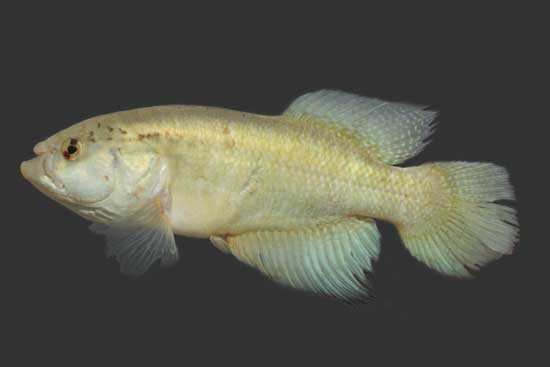
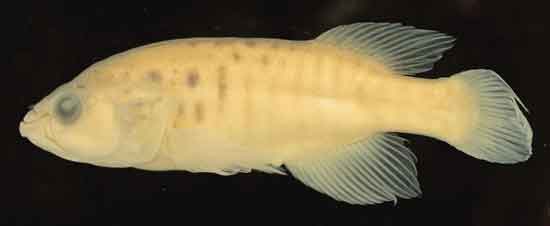
In contrast to most aplocheilid killifishes that are small, usually not surpassing 80 mm of standard length (SL), some species of Cynolebias often reach between 100 and 120 mm SL, and supposedly prey on small sym- patric seasonal killifishes (Costa 2001). All species of Cynolebias, except C. porosus Steindachner, 1876, were described after 1990 as a result of frequent recent efforts to sample the temporary pools of the Brazilian seasonal dry forests (e.g., Costa et al. 1990; Costa and Brasil 1991, 1993; Costa 2001, 2014; Costa et al. 2010). The subgenus Cynolebias has been divided in three species groups (e.g., Costa 2014), the C. gilbertoi, C. porosus and C. perforatus groups. Both the C. gilbertoi and C. perforatus groups are endemic to the São Francisco River basin, whereas the C. porosus group encompasses species endemic to most river basins of the Caatinga. Among species of the C. perforatus group, a clade including all species except C. rectiventer, the Cy- nolebias zeta-clade (Costa 2001), is the most diversified group of the genus. A new species of the C. gilbertoi group and another of the Cynolebias zeta-clade (hereafter CZC) were first collected in 2002 and 2005, respectively. Subsequent field studies showed that their habitats were drastically modified and they were not found in most re- cent field surveys. In the present study, descriptions of the new species and records of habitat decline for the last 15 years are provided.
Cynolebias gorutuba sp. n.
Holotype. UFRJ 6789, male, 88.8 mm SL; Brazil: Minas Gerais state: Janaúba municipality: temporary pool near road MG-401, floodplains of Gorutuba River, Verde Grande River drainage, São Francisco River basin, 15°47'57"S, 43°19'18"W, altitude about 525 m asl; W. J. E. M. Costa et al., 29 January 2010.
Paratypes. UFRJ 9447, 1 female, 50.1 mm SL; UFRJ 9448, 2 males, 50.7–83.9 mm SL, 1 female, 42.0 mm SL (C&S); same area as holotype, 15o48'06"S, 43o19'14"W, altitude about 525 m asl; W. J. E. M. Costa, C. P. Bove & B. B. Costa, 16 January 2016.
Reproduction
Breeding Cynolebias is not for inexperienced hobbyists. The species whitin the genus are relative large and need special attention in feeding and storing the eggs. Food demand is high as the species need to grow to adulthood within a few months and eggs need to be stored under very cool circumstances in wich a frigidaire could become a good tool.
As they live in stagnant pools and flooded areas that often are muddy and at the end of the rainy season around may and june becomes highly turbid, the water should be not low in pH. Temperature range can vary from 20 to 35 C.
Reproduction is best with one male and a number of big females. Tank need at least contain 60 liters and provide shelter for the females as male can be very agressive. Also females are known to be agressive to each other. Put a high container filled with neutral pH material like Coco peat or clay (or a mix of it) for spawning.
Eggs are 2.2 mm in diameter and need about 4 to 5 months to develop. Juveniles that grow faster than others should be separated from the smaller ones immediately as they prey on them.
Remarks :
These fishes are seldom available under hobbyists and only kept by specialists in bigger Killi species..
Variations
Map
Meristics
Max. size 88 mm in males - female smaller.
Dorsal (average, male only ) 18-19,
Anal (average, male only ) 21.0,
LL scale count (average) 38-41
Pre- dorsal length to SL – 60.0 %
Depth to SL – 33.1 %
Vertebrae count (average) 37-38
Literature