 Floridichthys carpio, Floridichthys carpio, |
History
This species was originally described as Cyprinodon carpio by A. Günther in 1866 already. Hubbs placed it in the new genus Floridichthys in 1926.
Read more about this Floridichthys carpio (Günther 1866) written by Charlie Nunziata, USA. (From the SKS newsletter vol. 2 2013)
Floridichthys carpio is one of two species in the genus, and is characterized by a single, spineless dorsal fin, abdominal pelvic fins, squared or rounded caudal fin and a scaly head (Robins & Ray 1986). The common name is Goldspotted Killifish and it is closely related to the pupfishes of the genus Cyprinodon, and the single species Jordanella.
Floridichthys carpio occurs in fresh, brackish and marine water in swamps and estuaries from southern Georgia throughout Florida and west to Louisiana. Typical habitats include seagrass beds, mangroves and salt mashes. This species aggregates into large schools in full strength and hypersaline sea water (Goldstein), and is occasionally found in freshwater, although this may be for short periods of time. Temperature tolerance is wide, from 42 to over 100º F (Bennett).
The slowly flowing marsh and mangrove habitats of F. carpio periodically undergo periods of hypoxia. Sensitive to low oxygen levels (Kaill), this fish probably moves to open water during low oxygen events. F. carpio schools in large aquaria with many individuals. It is most hardy in marine water, but brackish water may be sufficient. The largest male in a school may attain 3-4 inches, but all females and other males in that school will be smaller. The body of F. carpio is deep, short and chubby, with a convex profile (Robins & Ray 1986). The head is small. There are gray bars on the silver-blue flanks that break into spots in the rear. The lack of a dark spot at the base of the first dorsal fin ray differentiates this killifish from the similar species, Cyprinodon variegatus, with which it is often confused. See further comments on identifying this species later in this article.
Dominant and breeding males are more brightly colored, with yellow spots between the bars and concentrated on the back. The jaws are blue, the chin and lower mandible yellow. The operculum is also marked with yellow and blue, and there are orange-gold spots on the cheeks. The unpaired fins are light blue, the dorsal spotted, and dorsal and caudal may be edged in blue or orange. The pelvic fins are cream to yellow, sometimes clear.
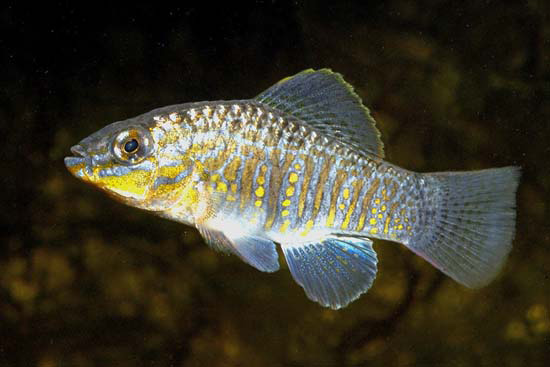

The female is silvery with gray bars and spots, and the unpaired fins clear to gray. F. carpio prefers surface feeding, but will feed at all levels on live, freeze-dried, frozen, and flake foods in-cluding spirulina (Terceira).
Especially young specimens of F. carpio can be mis-identified as the sheepshead minnow, Cyprinodon variegatus, and vice-versa. These species are similar in shape and coloration, and may be found in-habiting the same habitats. There are differences in adults that are easily identified, but these differ-ences are less obvious in juveniles. The dorsal surface of C. variegatus is less concave, and irregular, less formed dark bands extend over most of the flanks (Robins & Ray 1986). A dark spot is present at the base of the first dorsal fin ray, which is especially prominent in young indi-viduals and is a key to identifying C. variegatus from F. carpio.
Some young males and all adults exhibit a dark edge on the caudal fin. C. variegatus in breeding colors are easily identified with their intense colors; a blue nape and orange on the cheeks and throat, extending toward the abdomen. The irregular dark bands are also absent in breeding males. Adult F. carpio in breeding colors appear as primarily a yellow fish. Females have an ocellus, or eyespot, on the rear of the dorsal fin. At a maximum length of 7.5 cm, sheepshead minnows also grow slightly larger than F. carpio, and appear somewhat more robust.
Personal comment:
Thank you very much Charlie....a great contribution for me and the visiters to this site.
Reproduction
A 20-gallon marine aquarium equipped with killifish spawning mops for both cover and media best houses a small group (Terceira). Wildekamp recommends the use of a spawning mop that is longer than the tank is deep so that a significant portion of it lays on the bottom.
Preconditioning consists of copious feed-ings of live foods. Eggs are deposited in the mops in the typical killifish fashion, and hatch in 14 days at 74°F. (Terceira). The fry immediately take small newly hatched brine shrimp. A clump of plant matter may pro-vide supplement microorganisms for these small fry. Growth is slow, maturity requires 7 months.
The fry remain quietly on the bottom for weeks, so care must be taken not to remove them when changing water or removing debris (Terceira). F. carpio is probably a spring breeder stimulated by temperature or photoperiod. Males tend to be territorial during breeding.
Salt water killies are not as difficult as coral fishes to maintain. Typically, water changes are all that is necessary to breed and keep these fish in top shape.
Reproduction info also written by: Carles Nunziata.
Variations
Map
Meristics
Max. size SL 45 - 64 mm.
Dorsal 11-14,
Anal 9-11,
LL scale count 21-24
Pre- dorsal length to % SL – 0 %
Depth to % SL – 0 %
Literature
Studies of the fishes of the order Cyprinodontes VI. Miscelleaneous Publications of the Museum of Zoology of the University of Michigan 16: 16-17.