 Hypsolebias coamazonicus,
 |
History
Members of the Hypsolebias antenori species group comprise a diverse clade of morphologically similar seasonal killifishes occurring in a vast region of the semi-arid savannah of northeastern Brazil. The present paper focuses on an assemblage of three allopatric cryptic species (H. antenori from isolated coastal river drainages, Hypsolebias igneus from the São Francisco River basin and Hypsolebias coamazonicus sp. nov. from the Parnaíba River basin) sharing almost identical colour patterns, including the presence of an orangish red anal fin in males, thus herein named as the red-finned assemblage. A tree-based approach using mt-DNA (cytochrome b) supports delimitation of all three species, but indicates that the red-finned assemblage is paraphyletic – H. igneus and H. coamazonicus are closely related to Hypsolebias nudiorbitatus, whereas H. antenori is the sister group to a clade comprising all 13 species of the H. antenori group included in the analysis. Morphological characters are useful to diagnose species, but are not informative for most clades highly supported by molecular data. H. coamazonicus is distinguished from all other congeners by the possession of a dark grey or black stripe on the dorsal fin in males. The basal position of H. antenori is related to uplift episodes involving the Araripe-Borborema plateau during the Miocene, which isolated the coastal area inhabited by H. antenori from the remaining areas of the Caatinga. The sister group relationship between H. igneus and H. coamazonicus is attributed to a past connection between the São Francisco and Paranaíba River until the Tertiary.
Type locality: close to the road between Pirangi and Araioses, Parnaiba River floodplains, Maranhão state, municipio de Araioses, altitude 20 m, (northeastern) Brasil.
Discoverer(s): Pedro F. Amorim and Pedro H.N. Bragança, May 25. 2012.
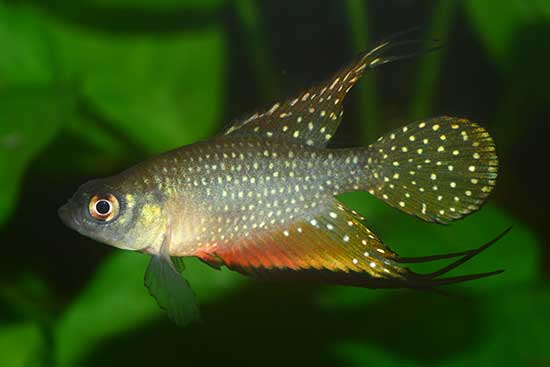


Diagnosis:
separated from related species by a dark grey to black band on distal margin of Dorsal fin in male and by minor morphomeristic characters (Costa, Bragança & Amorim, 2014).
Superspecies components:
H. coamazonicus, faouri, flagellatus, flavicaudatus, ghisolfii, gilbertobrasili, guanambi, heloplites, igneus, janaubensis, macaubensis, martinsi, mediopapillatus, nitens, nudiorbitatus, pterophyllus, radiseriatus, sertanejo.
Reproduction
This species can be productive, and the fry is small. Immediately after hatching, the fry should be fed with freshly hatched Artemia nauplii (brine shrimp) or better Paramecium. As most annual species do, they spawn by diving entirely into the substrate. It is best to provide a container with a lid on top in which a hole is made to allow the fish access. That container will need to have enough peat in it for the fish to dive completely into it. For most Hypsolebias species, egg development is complete after 8-10 weeks. However, it is wise also to check a few weeks earlier to see if any eggs have fully developed. Do not let the peat dry too far because the Hypsolebias like it moist. The development will be slower at storage temperatures between 21 and 24 Celsius and speed up at 25-29 Celsius. Before watering the
eggs, put some eggs in the water of about 18-20 degrees Celsius to see if the eggs hatch correctly. That usually happens within 2-6 hours. Then, if eggs hatched well and fry, swim correctly, bring all remaining peat in the water. You may need to re-pack the peat after pouring over the first group of fry to a larger tank. With regular water changes and sufficient food, the young will grow quickly, and after about 5-6 weeks, they can already produce their first eggs. Since this genus has an annual life cycle, the expected life span in captivity is not much more than 10 to 12 months. Their life expectancy is limited to when their pool still has water in the wild. This period can vary from 6 to 8 months.
Remarks:
Look for detailed info on this species at: https://www.killi-data.org/ Membership is free!
Variations
Map
Meristics
Max. size 45.8 mm.
Dorsal 22-30 in males, 11-17 in females.
Anal 21-22 in male, 18-21 in females.
D/A -7,
LL scale 25-28
Pre- dorsal length to % SL. 34.3 - 38.8 %
Depth to % SL – 31.0 - 33.7 %
Literature
Costa, W.J.E.M., P.F. Amorim & P.H.N. Bragança. 2014. Species Limits and phylogenetic Relationships of red-finned cryptic species of the seasonal killifish genus Hypsolebias from the Brazilian semi-arid Caatinga (Teleostei: Cyprinodontiformes: Rivulidae). J. Zool. Syst. Evol. Res., 52 (1) (February): 55, figs. 2a,4.
Britzke, R., D.T.B. Nielsen & C. Oliveira. 2016. Description of two new species of annual fishes of the Hypsolebias antenori species group (Cyprinodontiformes: Rivulidae), from Northeast Brazil. Zootaxa, 4114 (2): 123-138, 7 figs., 2 tabs.
Ponzetto, J.M., R. Britzke, D.T.B. Nielsen, P.P. Parise-Maltempi & A.L. Alves. 2016. Phylogenetic Relationships of Simpsonichthys subgenera (Cyprinodontiformes, Rivulidae), including a Proposal for a new genus. Zoologica Scripta, 45 ( 4)