 Hypsolebias lopesi, |
History
This species was described in the genus Simpsonichthys.
W. Costa (2006) assigned many members of the genus Simpsonichthys to the subgenus Hypsolebias (Costa 2006). Hypsolebias was subsequently elevated to a genus (Costa 2011). According to some scientists, the separation of Hypsolebias from the genus Simpsonichthys is insufficiently substantiated and, therefore, debatable.
Discoverer(s): Rogério dos Reis Suzart, Amer Faour Martín, Walber Stepple Hiluey, March 20. 2008.
Type locality:
Javi, near the riacho de Santana, rio São Francisco basin, city of Muquém de São Francisco, (northeastern) Brasil. The species was collected near the City of Muquém de São Francisco, locality of Javi in a temporary pool near the riacho de Santana, rio São Francisco basin at 12°12'3.60"S 43°39'28.08"W on March 20, 2008
Superspecies-components:
H. adornatus, alternatus, brunoi, caeruleus, carlettoi, delucai, fasciatus, flammeus, fulminantis, gardneri, hamadryades, harmonicus, hellneri, longignatus, lopesi, magnificus, multiradiatus, ocellatus, picturatus, shibattai, splendissimus, tocantinensis, trifasciatus.
Diagnosis: similar to multiradiatus and to adornatus, because of the elongated Dorsal fin base length of males that begins well anteriorly to the vertical line through the middle of the body, before Ventral fins origin, but separated from the former by the color pattern of its body and Anal fin without transverse lines (vs. with
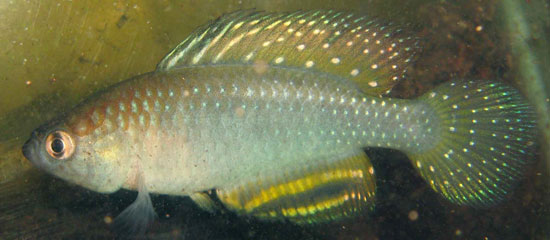
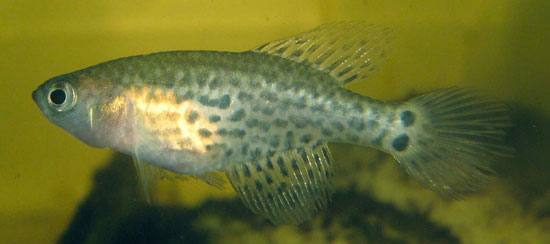
red transverse lines), and from the latter by the variable color pattern of the Anal fin, with male presenting yellow and dark lines or dark color with unlined yellow spots (vs. small blue spots) (Nielsen et al., 2010).
Simpsonichtys lopesi is described from a temporary pool located in the São Francisco river basin. This species is distinguished from remaining species, except H. adornatus, by the large number of dorsal fin rays, which makes possible a large dorsal fin base length that begins well anterior to the middle of the body, before the vertical line through the pelvic fin. This species differs from H. adornatus by the color pattern of the anal fin, which may have yellow stripes or light dots (vs. small light points), and also by the lower number of dorsal fin rays.
Reproduction
This species can be productive, and the fry is small. Immediately after hatching, the fry should be fed with freshly hatched Artemia nauplii (brine shrimp) or better Paramecium. As most annual species do, they spawn by diving entirely into the substrate. It is best to provide a container with a lid on top in which a hole is made to allow the fish access. That container will need to have enough peat in it for the fish to dive completely into it. For most Hypsolebias species, egg development is complete after 8-10 weeks. However, it is wise also to check a few weeks earlier to see if any eggs have fully developed. Do not let the peat dry too far because the Hypsolebias like it moist. The development will be slower at storage temperatures between 21 and 24 Celsius and speed up at 25-29 Celsius. Before watering the eggs, put some eggs in the water of about 18-20 degrees Celsius to see if the eggs hatch correctly. That usually happens
within 2-6 hours. Then, if eggs hatched well and fry, swim correctly, bring all remaining peat in the water. You may need to re-pack the peat after pouring over the first group of fry to a larger tank. With regular water changes and sufficient food, the young will grow quickly, and after about 5-6 weeks, they can already produce their first eggs. Since this genus has an annual life cycle, the expected life span in captivity is not much more than 10 to 12 months. Their life expectancy is limited to when their pool still has water in the wild. This period can vary from 6 to 8 months.
Remarks:
Look for detailed info on this species visit: https://www.killi-data.org/ Membership is free!
Variations
Map
Meristics
Max. size 45.8 mm.
Dorsal 22-30 in males, 11-17 in females.
Anal 21-22 in male, 18-21 in females.
D/A -7,
LL scale 25-28
Pre- dorsal length to % SL. 34.3 - 38.8 %
Depth to % SL – 31.0 - 33.7 %
Literature
Nielsen, D.T.B., O.A. Schibatta, R.D.R. Suzart and A.F. Martin, 2010. A new species of Simpsonichthys (Cyprinodontiformes: Rivulidae) from
the rio São Francisco basin, northeastern Brazil.