 Rivulus jauaperi, |
History
Alternative name Laimosemion jauaperi.
Abstract: Rivulus jauaperi was described as Laimosemion jauaperi member of the subgenus Owiyeye within the genus Laimosemion. This is confusing as a work from the French scientist and reknown specialist in Rivulus Dr. Jean Huber published a work in 2012 in which he proofed that the new genusnames provided by Costa in 2011 were not well supported. This species was collected by Pedro Barança, F. P. Ottoni & E. Henschel on september 15, 2012 along the auto route BR 175 near the equator.
Personal comment: The species was collected not far from the place where Rivulus uatuman was found. It seems to be close related and differs only in the color of the caudal anterior margin and in the fact one of the 2 animals (the female), from a single pair, that could be taken from the wild had not 5, but 4 ventral finrays.
Introduction in the original description:
A great biological diversity has been reported for the Amazon, the largest rain forest in the world, but only in recent years the occurrence of certain organisms living in special habitats has been first reported. This is the case of the small killifishes of the subgenus Owiyeye, presently placed in the genus Laimosemion, which are uniquely found in shallow pools within the dense forest (Costa, 2006, 2011). Whereas Amazon killifishes of the genus Anablepsoides are frequent in ichthyological col- lections because they occur in streams and lakes at the same place as other freshwater teleosts, species of Owiyeye, even when sympatric to spe- cies of Anablepsoides, are rarely found because they inhabit isolated shallow pools not sampled by most fish collectors (e. g., Costa, 2004a-c).
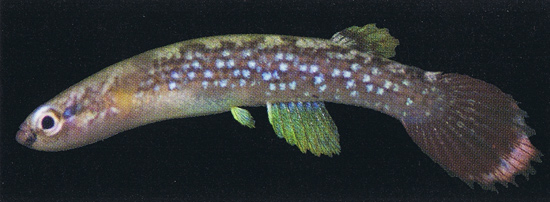
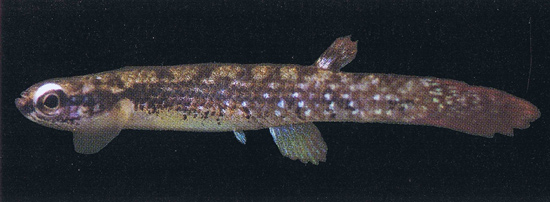
The image of the fish below is Rivulus (Laimosemion) uatuman for comparisation.

Among the six species endemic to the Amazonas river basin, only R. rectocaudatus, from the western Amazonas river basin in Peru, was not described in the last 10 years (Fels & de Rham, 1981). The other species described for the Amazonas river basin are: R. kirovskyi and R. uatuman from the central Brazilian Amazon (Costa, 2004a-b), and R. amanapira, R. romeri, and R. uakti from the upper Negro river drainage in Brazil (Costa, 2003, 2004c). A new species from the Negro river drainage is herein described.
Reproduction
Keeping and breeding is not easy and a good cover of the aquarium is necessary because there ability to jump, even true the smallest opening, is unbelievable.
This species can, if there is enough space for them, housed in a tank with more males than one only and several females. If separated before and brought together again however, they can be very agressive to each other and fight to become dominant to others. The best way to have some offspring is to put a pair or an trio in a small tank from 10 liters with a small filter in it or with some airation. On the bottom some peat moss or dark gravel and a floating "mop" to give space for laying there eggs. The fish will, if they become a rich varity of life food, spawn during there whole adult life and produce daily between 2 to 5 eggs.
The eggs should be collected by hand and stored for about 14 days in a small container. Eggs are 1.6 mm and amber colored. It is wise, to add some acryflavine to the water you store the eggs in, to provent fungus coming up. After hatching, the young fry can eat fresh artemia nauplii but it is wise to feed plancton also or add a lot of floating plants so they can find finest food there to. It takes 5 to 6 months to raise them to maturity. There lifespan can be up to 2 years in captivity.
Remarks :
This species is not in the hobby yet and the above is not my personal experience but as most small Rivulus are breeding the same way I believe this species behaviour will not be much different.
Variations
Map
Meristics
Max. size SL. 18.9 mm
Dorsal 6-7,
Anal 8-9,
Ventral female 4,
Ventral male 5,
LL scale count (average) 32,
Pre- dorsal length to % SL – 78.4 %
Depth to % SL – 16.9 %
Literature