 Rivulus nicoi, |
History
Alternative name Laimosemion nicoi.
Rivulus nicoi was found on 28 sept 1989 by Leo Nico at the right bank of the Rio Ventuari, Amazonas Territory in Southwest Venzuela. Rivulus nicoi was found in company with an, at that time new species of annual fish, and was described in the same paper with this annual fish named Pterolebias xiphoporus by Jaimie Tomerson & Donald Taphorn. (later renamed and transferred in a new genus as Micromoema xiphophorus (Costa) and in Micromoema xiphphora by Seegers in 2000)
Coordinates 4° 7'26.36"N 66°43'3.67"W
Both species were collected in a temporary pool about 500 meters inland from the right bank of the Ventuari river some 5,5 km upstream from the piont the Yureba river enters the Ventuari.
The authors did have only 5 juvenile alcohol specimen of this new Rivulus to their disposal and saw long pectoral fins as one of the most remarkable differences to other species of this genus. No detailed colours in life are described but it was mentionned by Leo Nico the species showed blue colouration on the body. Both sexes did show a "rivulus" spot. This however is very common in Rivulus in their first stage of life and does not implicate both sexes will show these spots also in their adult stage of life. Also the fact that the species was found together with a confirmed annual was reason for the describers to suggest this Rivulus species could be a semi-annual too as result of their ocurrence in a annual biotope. They quoted the species was "a not confirmed annual" however.
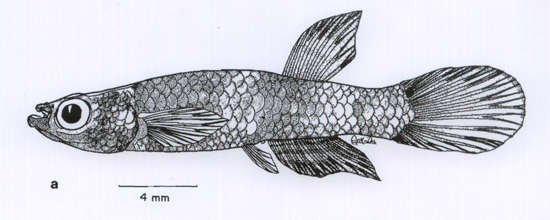
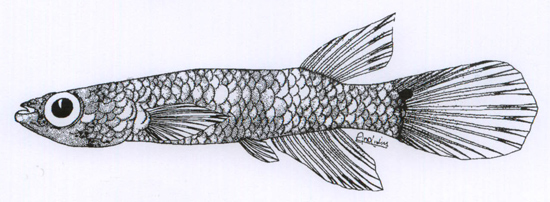
It was my goal in (April 2012) to collect life fishes from the terra typica to learn more about this species and its behaviour. This expedition was one of the most challenging ones so far as travelling to that spot had to take place under extreme circumstances on the Orinoco- and Ventuari river and the outcome was unsecure as April is the dry season while the species was discovered in October 1989 which was during the rainy season. To reach the spot we needed to make a boat trip of over 350 km upriver and 350 km downriver also to return to the basecamp at Puerto Ayacucho. There is no other way to get to it. The rivers will be low and the annual habitat will be dried out completely, but on the other hand the Rivulus will survive somewhere in remaining creeks and swamps nearby I believe.
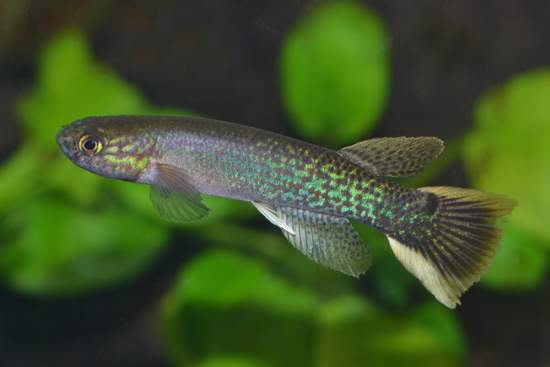
The fish on the image above may be different than R. nicoi and a possible new taxon but for sure show annual behaviour. It is subject of a study in the making. (March 2019)
During that International Venezuelan Expedition we did collect in a small stream in the Galery forests near the mouth of the ventuari about 46.6 KM downstream to the place Leo Nico did find the fishes described after him. We succeded not to get closer to the terra typica and could only collected the species in the photo above.
Reproduction
Since no breeding report was given of the Rivulus nicoi because the samples had only been delivered to the descriptors as preserved specimens, no confirmation can be given either as to whether the breeding behavior is different from the usual way of propagation or not.
About the Rivulus species we caught in 2012 as shown in the photo, I can report that it exhibits behavior similar to that known from annuals, with the note that they do not submerge in the substrate. Below is a brief report of their breeding.
This is a very strange Rivulid fish species. The fish behave like belly sliders while mating. Male and female dwell along the bottom and lay their eggs only on the bottom. If a mop is available, they do not use it. It is best to put a layer of peat and forest leaves on the bottom where they will spawn. Eggs become covered with peat particles and are difficult to find. The eggs are amber in color and a little sticky.
The first eggs were collected around December 2012 and these eggs are still developing and are in a long diapause. It is clear that this species is a unique annual fish. Storage in water with some trypaflavin results in loss of most eggs. Storage on peat also results in losses, but less. If peat is fairly moist it seems to fare better.... This is the first ever breeding report of this fish and I still don't know how long it takes for the eggs to fully develop (April - 2013)
Remarks :
No photographs of live Rivulus nicoi have been taken. Also, the species has never been in the hobby.
Variations
Map
Meristics
Max. size 3.0 cm. ( adult size not known)
Dorsal 8.4,
Anal 12.8,
D/A 5.4,
LL scale count (average)27.2
Pre- dorsal length to % SL – 74.1 %
Depth to % SL – 20.2 %
Literature
Thomerson, J.E. % D.C. Taphorn. 1992. Two new annual Killifishes from Amazonas Territory, Venezuela (Cyprinodontiformes: Rivulidae). Ithyol. Explor. Freshwaters, 3 (4): 380, fig. 4. PDF (right click to open in new window)