 Rivulus paryagi, , |
History
Alternative name Laimosemion paryagi.
Rivulus paryagi is described from the upper Mazaruni river system, a tributary of the Essequibo River. It is a member of the R. breviceps group former known as the Rivulus breviceps group, and shares a robust body and deep caudal peduncle with R. breviceps (Eigenmann, 1909) and R. lyricauda (Thomerson et al., 1991) and to a lesser degree with R. gransabanae (Lasso et al., 1992) and R. torrenticola (Vermeulen & Isbrücker, 2000). These species are all endemic to the Guiana Highlands in western Guyana and the neighbouring Gran Sabana in Eastern Venezuela.
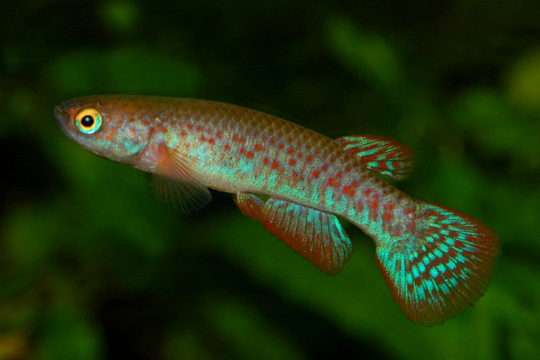
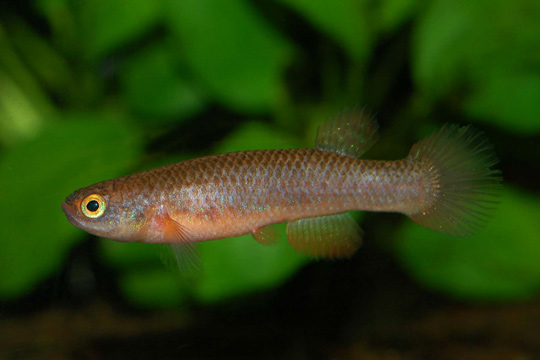
Rivulus paryagi is
distinguished from other species in the R. breviceps group
by morphology and its remarkable male color pattern of
red blotches on a turquoise ground color on the flanks and
in the unpaired fins and having a rounded caudal fin as
opposed to congeners having extensions or having spade shaped caudal-fins.
Analysis of mitochondrial DNA sequence reveals that it is
genetically distinct from all other members of this group
and that inhabitants of the Guyana highlands diverged
from each other early in the history of the genus, commensurate
with the geological age of the Guiana Shield.
Reproduction
Keeping and breeding is easy but a good cover of the aquarium is necessary because there ability to jump, even true the smallest opening, is unbelievable. As the species lives in mountainous ares under the cover of the primary forest canope this species does not like high temperatures. Between 20 and 23 C is OK.
This species can, if there is enough space for them, housed in a tank with more males than one only and several females. If separated before and brought together again however, they can be very agressive to each other and fight to become dominant to others. The best way to have much offspring is to put a pair or an trio in a small tank from 10 liters with a small filter in it or with some airation. On the bottom some peat moss or dark gravel and a floating "mop" to give space for laying there eggs. The fish will, if they become a rich varity of life food, spawn during there whole adult life and produce daily between 5 to 15 eggs.
The eggs should be collected by hand and stored for about 14 days in a small container. Eggs are 1.8 mm and amber colored. It is wise, to add to the water you store the eggs in, some acryflavine to provent fungus coming up.
After hatching the young fry can eat fresh artemia nauplii without any problem. It takes 4 to 6 months to raise them to maturity.
There lifespan can be up to 4 years in captivity.
Remarks :
Variations
Map
Meristics
Max. size 4,5 cm.
Dorsal 9.1
Anal 12.6
D/A 6.6
LL scale count (average)32.4
Pre- dorsal length to % SL – 70.5 %
Depth to % SL – 22.6 %
Literature
Vermeulen F.B.M., W. Suijker & G. Collier 2012. Laimosemion paryagi (Cyprinodontiformes: Aplocheiloidei: Rivulidae), a new species from the upper Mazaruni river drainage of western Guyana. Aqua, Internat. Journal of Ichthyology, Vol. 18 no. 4 - 15 October. 181-190, fig 8, table 1.