 The genus Leptolebias, |
The genus Leptolebias was described by Myers in 1952 in the first place as a subgenus within the genus Cynolebias. Before that time, the Leptolebias species were scientificly assigned to Cynolebias. Nowadays the former subgenus Leptolebias is seen as genus of its own. Costa (1990)
A phylogenetic analysis based on morphological characters indicates that Leptolebias Myers, 1952, a genus of small killifishes highly threatened with extinction, from Brazil, is paraphyletic. As a consequence, Leptolebias is restricted to a well-supported clade that includes Leptolebias marmoratus (Ladiges, 1934), Leptolebias splendens (Myers, 1942), Leptolebias opalescens (Myers, 1942), and Leptolebias citrinipinnis (Costa, Lacerda & Tanizaki, 1988), from the coastal plains of Rio de Janeiro, and Leptolebias aureoguttatus (Cruz, 1974) and Leptolebias itanhaensis sp. nov., from the coastal plains of São Paulo and Paraná, in southern Brazil. Leptolebias is diagnosed by three synapomorphies: a caudal fin that is longer than deep, a single anterior supraorbital neuromast, and dark pigmentation that does not extend to the distal portion of the dorsal fin in males. A key is provided for the identification of species of Leptolebias. Three species formerly placed in Leptolebias, Leptolebias minimus (Myers, 1942), Leptolebias fractifasciatus (Costa, 1988), and Leptolebias cruzi (Costa, 1988), are transferred to Notholebias gen. nov., which is hypothesized to be the sister group to the clade comprising Leptolebias, Campellolebias Vaz-Ferreira & Sierra, 1974, and Cynopoecilus Regan, 1912. Notholebias gen nov. is diagnosed by two synapomorphies: a narrow basihyal and the presence of iridescent bars on the caudal fin in males; and three features interpreted as plesiomorphic, but not occurring in Leptolebias, Campellolebias, or Cynopoecilus, the presence of dermosphenotic, well-developed contact organs on the pectoral fin in males, and an opercular region with red bars in males. ‘Leptolebias’ leitaoi, a species from Bahia, in north-eastern Brazil, is considered as having an uncertain phylogenetic position, as all known preserved material is presently lost, and the species may be extinct.
They are related to Cynolebias and Cynopoecilus and of course to the new erected genus Notholebias but show remarkable differences to Cynolebias also. In contrary to Cynolebias, Leptolebias- females do not show any black markings at there sides and are pale brown without any markings on the fins either. The body shape of Leptolebias is more slender with a less deep bellied shape as in Cynolebias or Simpsonichthys. Also their maximum total length is less than in Cynolebias. The males of all Leptolebias are very attractive in their colour- and pattern and are fantastic aquariumfishes. Unfortunately they use(d) to live along the coast of south- east Brasil the majority of them around the city of Rio de Janeiro where, in the past 50 years, human activity destroyed many habitats.
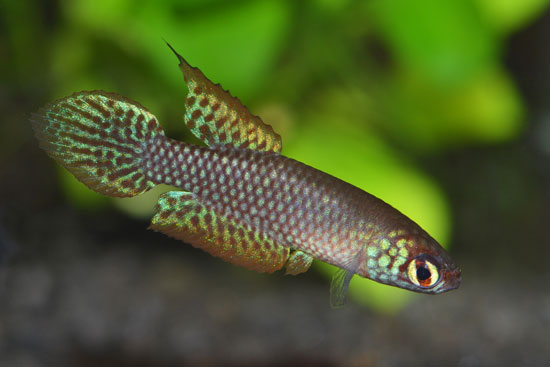
This was the result of urbanisation and agricultural activity. Often, the ocurrence of a species was recorded from a single temporary pool or a small isolated area. Nowadays it is forbidden by Brasilian law to collect-, keep-, transport- or ship all kind of plants and animals without proper permission provided by the government. All Leptolebias species are regarded as endangered. Scientific surveys learned that it might be to late for some of them.
Beeding programs of aquarists are however the only way to do something against total loss of these species. The original habitats become smaller and smaller every day and the fact these fishes will disappear complete is a matter of time. In that case, the way of protection by the Brasilian law will have a negative impact on there chance to survive.
Behaviour:
It can get rather cool in the area were Leptolebias lives during wintertime. Therefore they need to be held cool during there life as low as 18 C with a maximum of 23 C. In the summer temperatures can rise also very high you could say and that is thrue. Originally however, these species lived there live's in area's covered with forests. Nowadays most forest are disappeared and replaced by agricultured land, only a few habitats are left untouched in hilly terrain. During warmer periods the forests canope protected there habitats from getting to warm. So, urbanisation has in many ways reduced the habitats and living conditions of Leptolebias and other similar genera.
As they are real seasonal fishes they need to put there eggs into the soil to develop after a dry period. Eggs are pressed into the soil but parents do not dive into it. Eggs are very small, less than 1 mm and the fry need very small food like infusoria during the first week or two. In nature, infusoria will develop after high water by innundating dead plants that became dry as pools dried up before to.
After 6 to 12 weeks incubation the eggs will be ready to hatch. For more details on reproduction go to the species pages.