 Rivulus amambaiensis, |
History
Alternative name Melanorivulus amambaiensis.
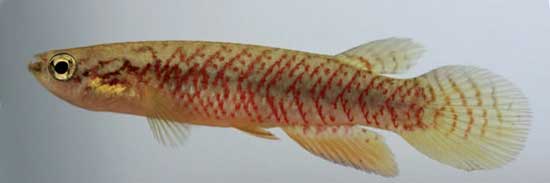
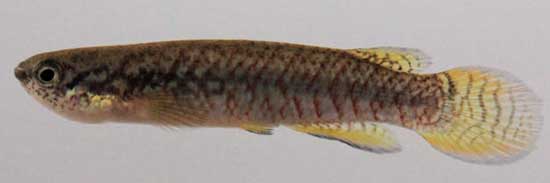
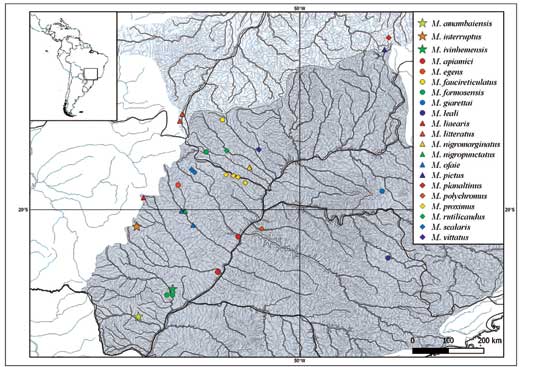
The subgenus Melanorivulus presents a wide geographical distribution in the Neotropical region. Among Rivulus, the R. pictus species group has currently 18 species distributed in the Brazilian Cerrado, mainly in the upper Rio Paraná basin, with some species occurrences in the upper Rio Araguaia and Tocantins. In the present study, we describe three new Rivulus species, belonging to the R. pictus species group from different drainages of the right bank of the Rio Paraná basin in Mato Grosso do Sul state, Brazil. These new species are easily distinguished from the others by their unique colour patterns. Rivulus interruptus is distinguished from all species of the R. pictus group by the presence of oblique chevron-like red bars interrupted, mainly on the midline of the flank in males; while R. ivinhemensis by the yellow colouration of the caudal fin with thin red bars arranged only in the median region of the fin in males. Rivulus amambaiensis is distinguished from all species of the R. pictus species group by having an orange anal fin or sometimes more reddish-orange with distal margin grey or dark grey and chevron-like bars along the body, distinctly branched ventrally forming an inverted Y-shape in males. The high diversity of the Rivulus species with high levels of endemism demands the development of conservation strategies to avoid the loss of their vulnerable habitats in the Cerrado biome. We expect presence of more species of the R. pictus species group also along the lower reaches of the tributaries of the Rio Paraná. Additionally a dichotomic identification key of the R. pictus species group is provided.
Introduction: Savanna biomes are distributed across tropical zones around the world. In South America, the Cerrado is the largest savanna biome, the second largest biome in Brazil (smaller only than the Amazon), and represents about 23 % of Brazilian territory (Ratter et al. 1997). The Brazilian Cerrado is included in the world’s 25 main “hotspots”, areas with many rare and endemic species and less than 30% remaining natural vegetation (Myers et al. 2000).
It is one of the world’s most threatened biomes, mainly because of the replacement of natural vegetation by pastures and row crops (Ratter et al. 1997, Myers et al. 2000). The rivulid genus Rivulus is a typical compo- nent of the Cerrado fauna, but presents a wide geograph- ical distribution in the Neotropical region, being also found in areas under the influence of the Chaco, Pantanal, Atlantic Forest and Amazon (e.g. Costa 2016, Costa et al. 2016, Nielsen 2017). However, most of the species are found in Brazil and occur in the Cerrado biome along several river basins drained mainly by the upper tributaries of the Rio Araguaia, Tocantins, Paraná and Paraguay basins and the adjacent Cerrado-Amazon ecotone (Costa et al. 2016). Recent killifish inventories of the Brazilian Cerrado have revealed a high diversity of Rivulus species (e.g., Costa 2012, 2017, 2018, Volcan et al. 2017), indicating that species inhabiting the region have small geographical ranges, often restricted to short segments of a single river drainage (Costa 2017, Volcan et al. 2017). Despite the wide geographical distribution and high diversity, little is known about the conservation, distribution, biology and ecology of most Rivulus species (Severo-Neto and Volcan 2018).
Reproduction
Keeping and breeding is easy but a tight fitting cover on the aquarium is necessary because their ability to jump, even through the smallest opening, is unbelievable.
This species can, if there is enough space for them, be housed in a tank with more than one male and several females. If separated before and brought together again however, they can be very aggressive towards each other and fight to become the dominant fish. The best way to produce numbers of fry is to put a pair or a trio in a small tank of about 10 litres with a small filter in it or with some aeration. On the bottom of the tank place some peat moss or dark gravel and a floating "mop" to give space for laying their eggs. The fish will, if they are fed a rich variety of live food, spawn during their whole adult life and produce daily between 5 to 15 eggs.
The eggs should be collected by hand and stored for about 14 days in a small containeM. Eggs are 1.6 mm and amber coloured. It is wise to add an anti fungus to the water you store the eggs in, to prevent fungal attacks.
After hatching the young fry can eat fresh artemia nauplii without any problem. It takes 4 to 5 months to raise them to maturity. Often the males far out number females. For some species this can become a major problem for the breeder, as he has to raise many fry to enable distribution of a few pairs to other hobbyists. Recent personal tests found that lower pH levels during the time of hatching gave a higher percentage of females. To achieve this I used some peat moss that I added to the container with the eggs just before they were ready to hatch. This peat moss also is a good way to prevent eggs from being attacked by fungus.
Their lifespan can be up to 3 years in captivity.
Remarks :
Variations
Map
Meristics
Max. size 0.0 cm.
Dorsal 00.0,
Anal 00.0,
D/A 0.0,
LL scale count (average) 00.0
Pre- dorsal length to % SL – 00.0 %
Depth to % SL – 00.0 %
Literature