 Rivulus kayabi, Rivulus kayabi, |
History
Alternative name Melanorivulus kayabi.
Rivulus kayabi was described by the Brasilian scientist W.J.E.M. Costa at the end of the year 2007.
Rivulus kayabi was discovered in the Tapajos River drainage.
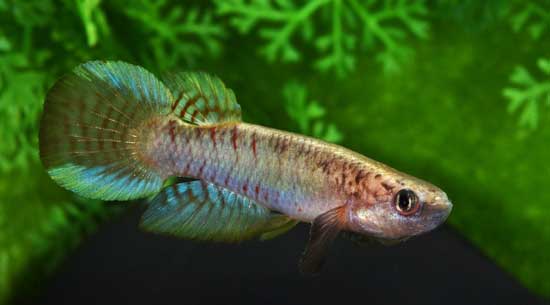
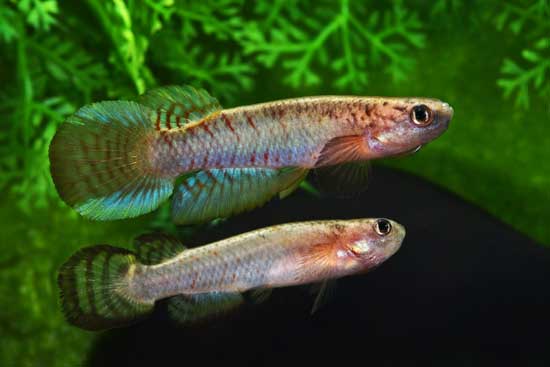
It is similar to other species of Rivulus from southern Amazonian tributaries of central Brazil by having a unique color pattern of flank, consisting of red marks arranged in a chevron-like pattern with vertex on the ventral portion of the flank. It differs from all other species of this region by a combination of 31-33 scales in the longitudinal series, a horizontal series of white spots on the dorsal portion of the caudal fin in females,13 pectoral-fin rays, and 28-31 caudal-fin rays.
(source: Killi Data Online, Dec, 2007.)
Reproduction
No detailes yet but is believed not to be different from other species within the Melanorivulus subgenus. So, keeping and breeding is easy but a good cover of the aquarium is necessary because there ability to jump, even true the smallest opening, is unbelievable.
This species can, if there is enough space for them, housed in a tank with more males than one only and several females. If separated before and brought together again however, they can be very agressive to each other and fight to become dominant to others. The best way to have much offspring is to put a pair or an trio in a small tank from 10 liters with a small filter in it or with some airation. On the bottom some peat moss or dark gravel and a floating "mop" to give space for laying there eggs. The fish will, if they become a rich varity of life food, spawn during there whole adult life and produce daily between 5 to 15 eggs.
The eggs should be collected by hand and stored for about 14 days in a small container. Eggs are 1.6 mm and amber colored. It is wise, to add to the water you store the eggs in, some acryflavine to provent fungus coming up.
After hatching the young fry can eat fresh artemia nauplii without any problem. It takes 4 to 5 months to raise them to maturity. Often the number of males is far above the number of females. For some species this can become a major problem for the breeder as he has to raise many young fishes and so become able to distribute a few pairs to other hobbyists. Recent personal tests laerned that lower pH levels during the time of hatching gave a higher percentage of females. To achieve this I use some peat moss that I add to the container with the egss just before they are ready to hatch. This peat moss also is a good way to prevent eggs to become attact by fungusses.
There lifespan can be up to 3 years in captivity.
Remarks :
I like to thank Rudolf Pohlmann, Germany for his nice photos of this species.
Variations
Map
Meristics
Max. size 0.0 cm.
Dorsal 00.0,
Anal 00.0,
D/A 0.0,
LL scale count (average) 00.0
Pre- dorsal length to % SL – 00.0 %
Depth to % SL – 00.0 %
Literature
Costa, W. J. E. M. (2007)
Rivulus kayabi, a new killifish from the Tapajós river basin, southern Brazilian Amazon (Cyprinodontiformes: Rivulidae)
Ichthyological Exploration of Freshwaters, 18 (4), 345-350.