 Rivulus linearis, Rivulus linearis, |
History
Rivulus linearis is originally described in Melanorivulus however seen here as subgenus of the monophyletic genus Rivulus.
Three new species of Rivulus are described from the upper and middle Rio Paraná Basin, central Brazilian Cerrado. These species are members of the R. pictus species group, endemic to central Brazilian plateaus and adjacent areas, and are easily diagnosed by colour pattern characters, but their relationships with other congeners of the group are still uncertain. Rivulus proximus sp. n., from the middle Rio Aporé drainage, and R. nigromarginatus sp. n., from the Rio Corrente drainage, are possibly more closely related to other species endemic to streams draining the slopes of the Caiapó range, whereas R. linearis sp. n., from the upper Rio Pardo drainage, middle Rio Paraná Basin, is considered more closely related to R. egens, a species also endemic to this part of the Basin. This study corroborates the high diversity of species of Rivulus in the central Brazilian Cerrado plateaus repeatedly reported in previous studies, indicating once more that different species are often found restricted to short segments of the same river drainage. The intense habitat loss recorded in recent years combined to the high species diversity limited to specific Cerrado freshwater ecosystems, the veredas, indicates that species of Rivulus endemic to this part of the Brazilian Cerrado are highly threatened with extinction.
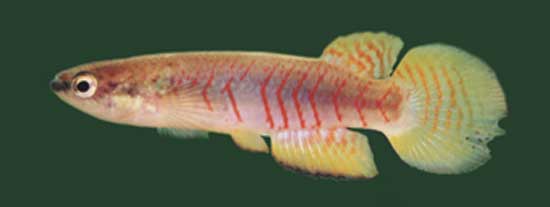
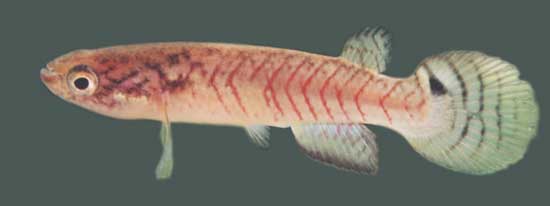
Reproduction
Keeping and breeding is easy but a tight fitting cover on the aquarium is necessary because their ability to jump, even through the smallest opening, is unbelievable.
This species can, if there is enough space for them, be housed in a tank with more than one male and several females. If separated before and brought together again however, they can be very aggressive towards each other and fight to become the dominant fish. The best way to produce numbers of fry is to put a pair or a trio in a small tank of about 10 litres with a small filter in it or with some aeration. On the bottom of the tank place some peat moss or dark gravel and a floating "mop" to give space for laying their eggs. The fish will, if they are fed a rich variety of live food, spawn during their whole adult life and produce daily between 5 to 15 eggs.
The eggs should be collected by hand and stored for about 14 days in a small container. Eggs are 1.6 mm and amber coloured. It is wise to add an anti fungus to the water you store the eggs in, to prevent fungal attacks.
After hatching the young fry can eat fresh artemia nauplii without any problem. It takes 4 to 5 months to raise them to maturity. Often the males far out number females. For some species this can become a major problem for the breeder, as he has to raise many fry to enable distribution of a few pairs to other hobbyists. Recent personal tests found that lower pH levels during the time of hatching gave a higher percentage of females. To achieve this I used some peat moss that I added to the container with the eggs just before they were ready to hatch. This peat moss also is a good way to prevent eggs from being attacked by fungus.
Their lifespan can be up to 3 years in captivity.
Remarks :
Variations
Map
Meristics
Max. size 0.0 cm.
Dorsal 00.0,
Anal 00.0,
D/A 0.0,
LL scale count (average) 00.0
Pre- dorsal length to % SL – 00.0 %
Depth to % SL – 00.0 %
Literature