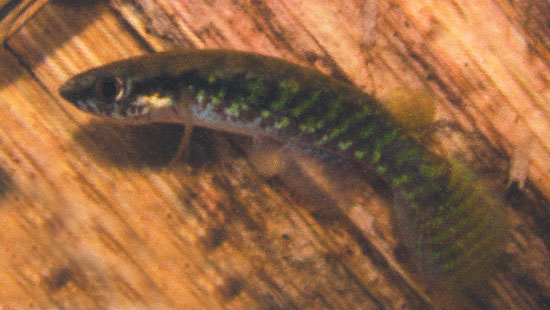
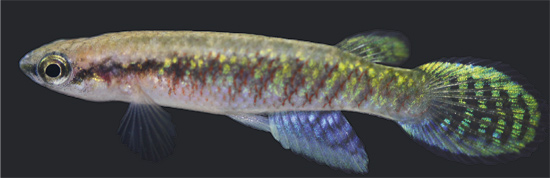
 Rivulus schuncki, |
History
Alternative name Melanorivulus schuncki.
Rivulus schuncki is originally described by Dr. Wilson Costa and Andre C. de Luca as Melanorivulus schuncki.
Rivulus schuncki is known from the type locality, a small clear water stream tributary to the Vila Nova River, which is a tributary of the Anauerapucu River drainage, Amapá state, northern Brazil. The Anauerapucu River empties directly on the left margin of the Amazonas River delta. The stream was about 3 m wide and 2 m deep at the type locality area, but all individuals of the type series were collected near the stream bank, in places between 5-50 cm deep. The type locality area is within a savanna area, the stream margins being densely populated by the buriti-palm Mauritia flexuosa. On the map below a number of other localities is shown including the type locality of Rivulus albae that was synonymized with this R. schuncki in 2012.
Reproduction
Keeping and breeding is easy but a tight fitting cover on the aquarium is necessary because their ability to jump, even through the smallest opening, is unbelievable.
As all members of the genus Rivulus this species can, if there is enough space for them, be housed in a tank with more than one male and several females. If separated before and brought together again however, they can be very aggressive towards each other and fight to become the dominant fish. The best way to produce numbers of fry is to put a pair or a trio in a small tank of about 10 litres with a small filter in it or with some aeration. On the bottom of the tank place some peat moss or dark gravel and a floating "mop" to give space for laying their eggs. The fish will, if they are fed a rich variety of live food, spawn during their whole adult life and produce daily between 5 to 15 eggs.
The eggs should be collected by hand and stored for about 14 days in a small container. Eggs are 1.6 mm and amber coloured. It is wise to add an anti fungus to the water you store the eggs in, to prevent fungal attacks.
After hatching the young fry can eat fresh artemia nauplii without any problem. It takes 4 to 5 months to raise them to maturity. Often the males far out number females. For some species this can become a major problem for the breeder, as he has to raise many fry to enable distribution of a few pairs to other hobbyists. Recent personal tests found that lower pH levels during the time of hatching gave a higher percentage of females. To achieve this I used some peat moss that I added to the container with the eggs just before they were ready to hatch. This peat moss also is a good way to prevent eggs from being attacked by fungus.
Remarks :
The species is in the hobby but not spread out very much jet, so all info about keeping and breeding Rivulus schuncki is based on general data for this group of killies.
Variations
Map
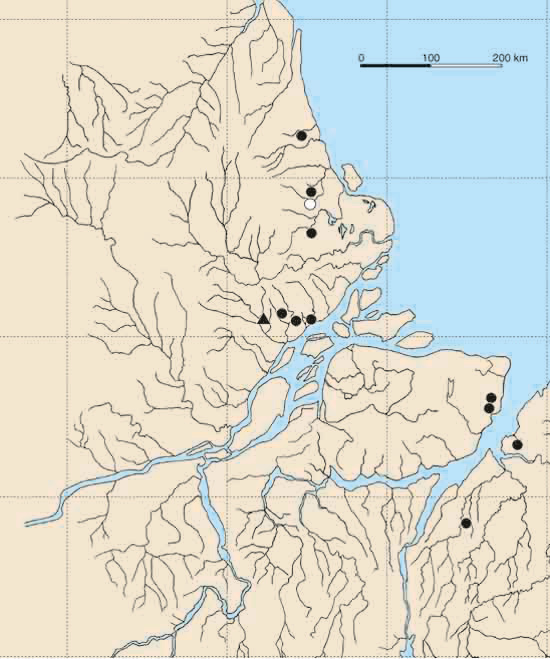
Map: Geographic distribution of Rivulus schuncki: triangle=type locality; white circle type locality of R. albae; black circles other localities
Meristics
Max. size 2,5 cm. (after description)
Dorsal 8-9,
Anal 11-13,
D/A 9,5,
LL scale count (average) 29
Pre- dorsal length to % SL – 00.0 %
Depth to % SL – 00.0 %
Literature
Costa W.E.J.M., A.C. De Luca, 2010. Rivulus schuncki, a new species of the killifish subgenus Melanorivulus, from eastern Brazilian Amazon (Cyprinodontiformes:Rivulidae) Ichthyol. Explor. Freshwaters, Vol. 21, No. 4, pp. 289-293, 1 fig., 1 tab.,
Valdesalici S., J. R. G. Gil & D. T. B. Nielsen. 2011. Rivulus albae, a new species of killifish (Teleostei: Cyprinodontiformes: Rivulidae) from northeastern Brazil. Vertebrate Zoology, 61 (1) 105 – 108.
Costa, W. J. E. M. 2011. Phylogenetic position and taxonomic status of Anablepsoides, Atlantirivulus, Cynodonichthys, Laimosemion and Melanorivulus (Cyprinodontiformes: Rivulidae). Ichthyological Exploration of Freshwaters, 22 (3): 233-249.
Reappraisal of the Phylogeny of Rivulus and its Allied focused on External Characters. Huber, J.H.: Killi-Data Series 2012, 9-25.