 Moema staecki, Moema staecki, |
History
Seegers named this fish after the well known aquarist and amateur ichthyologist Dr. Wolfgang Staeck, Berlin, Germany, explorator and discoverer of the species. The original type locality of Moema staecki is situated at the Lagoon of Lake Janauaca, on the southbank the Amazon River, just above the mouth of the Rio Negro, southwest from Manaus, Brasil.
At the time of description it was grouped in the genus Pterolebias it was moved by Huber into Trigonectes (1994) but split by Costa (1993) to the new erected genus Moema.
The status of the genus should be reworked after Huber (Killi Data) in consideration of non typical populations from the Amazon basin and (Brit.) Guyana. A lot of future research is needed to clear questions that still remain.
The images to the right show a strong resembling fish that was found at the edge of the Rupununi- savanna, Guyana where the Rio Branco springs (at that location named Takatu River) .
As explained in the introduction to Moema, this species could spread by main rivers, belonging to the Amazon River, and did find their way in all directions seeking for niches at shallow beaches and isolated pools after flooding.
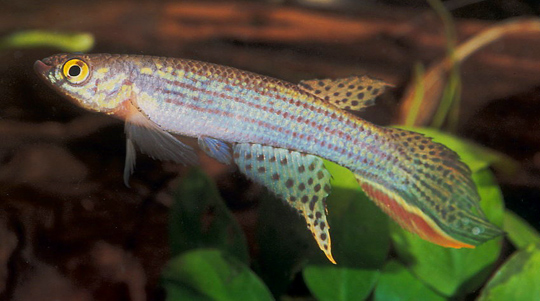
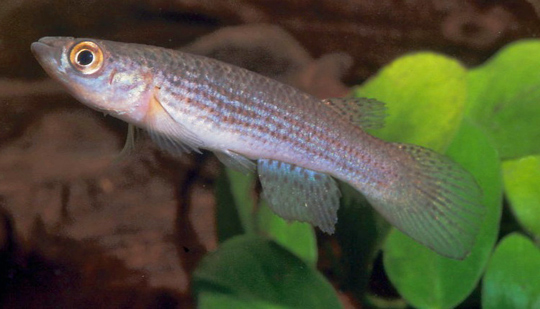
Reproduction
Keeping and breeding Moema is easy but it takes some patience from the breeder, a bigger breeding tank and special breeding container. The eggs need long incubation periods up to 10 months. Normally, eggs are ready to hatch after 5 to 6 months.
To produce many egss the parents need to get life food only in a rich varity and mass. As all fast growing SAA's they do not like dry food and rather die than get used to is. Sometimes they eat frozen foods also but you should never skip the life food for them. They can be very productive and the best set-up is one male and 2 or more females in an tank from 25 to 40 litrs. Males are not to agressive against females as you will see.
They are peacefull fishes and only males can get agressive to each other especilally if they were separated from each other for a while before.
Storing the egss is easy to but, as said before, a matter of patience. You must boil the peat, before you use it in the breeding tank. I use deep containers with peat to avoid food enters the peat and later affects the eggs by fungus. This also to keep the amount of peat as small as possible but the layer high enough so the fish can dive in completely. After spawning during 2 weeks the peat is squeezed out and dried to an level of fresh tabacco. Storing at 25 C. in a dark place. After a few months it is wise to inspect the peat if eggs are stil there and if any development in it is visable already. Because eggs need an long incubation time it is recommended to check the peat bi- monthly if this is still wet enough. If peat is put away very moist and warm (up to 28 C.) is is possible the eggs will hatch in an earlier stage. It is however also possible the eggs disappeare all by fungus.
Their lifespan can be up to 1.5 years in captivity but they will not get that chance in annatural invironment.
Variations
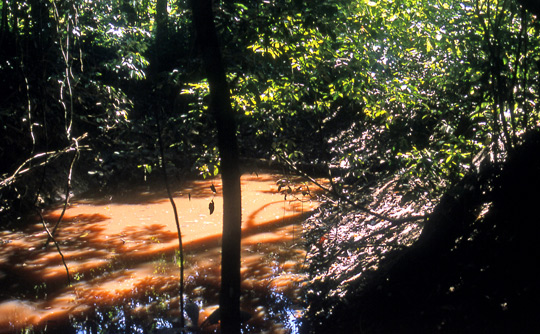
At the image above you see the Moema aff. staecki found in Guyana in the Essequibo River system. This river is thru its branch, the Rupununy River, and the nearby Takatu River, branch of the rio Branco, during rainy seasons connected to the rio Branco, and by that to the Rio Negro and Amazon River. During the seasonal flooding of the rupununi savannah the source of both riversystems is the very same Rupununi savannah.
It is possible the species could spread by this event into the Essequibo that flows north to end up in the ocean by itself.
Map
Meristics
Max. size 12.0 cm.
Dorsal 7.6,
Anal 14.4,
D/A 8.0,
LL scale count (average)35.2
Pre- dorsal length to % SL – 76.3 %
Depth to % SL – 19.4 %
Literature
Seegers, L. 1987. Die Gattung Pterolebias Garman, 1895, mit der beschreibung von Pterolebias staecki. Aquar.Terr.Zeit. (D.A.T.Z.), 40 (5); 202, fig.