 Mucurilebias leitaoi, |
History
This species was originally described as Leptolebias leitaoi. Recently Prof. Wilson Costa erected a new genus for this taxon and below you find a part of the introduction in this work.
The tribes Cynolebiasini and Cynopoecilini are wellcorroborated clades of killifishes, belonging to the seasonal killifish subfamily Cynolebiasinae, with the Cynolebiasini comprising seven genera (Austrolebias Costa, 1998, Cynolebias Steindachner, 1877, Hypsolebias Costa, 2006, Nematolebias Costa, 1998, Simpsonichthys Carvalho, 1959, Spectrolebias Costa & Nielsen, 1997, Xenurolebias Costa, 2006) and the Cynopoecilini comprising four genera (Campellolebias Vaz-Ferreira & Sierra, Cynopoecilus Regan, 1912, Leptolebias Myers, 1952, and Notholebias Costa, 2008, 2010). In addition, Costa (2008) recognised an incertae sedis cynopoeciline species, ‘Leptolebias’ leitaoi (Cruz & Peixoto, 1991) that could not be properly placed in any genera. ‘Leptolebias’ leitaoi is known only from the floodplains of the Mucuri river, an area about 500 km north from the geographically nearest Cynopoecilines (Costa, 2008). All the known specimens of ‘L’. leitaoi were collected in 1988, within a cacao farm close to the Mucuri river bank (Cruz & Peixoto, 1991). The whole region was subsequently highly modified by a cellulose industry and great part of the original forest was substituted by cattle pastures few years after the discovery of ‘L’. leitaoi. As a consequence, the species was never found again (Costa, 1995, 2009). Since the type series was lost, determination of the phylogenetic position of ‘L’. leitaoi depends on the single specimen of the species presently known to be preserved in a fish collection (Costa, 2008). This specimen was collected with the type series, kept in aquaria and fixed, cleared and stained just after dying. Consequently, some diagnostic characters could not be examined and the phylogenetic position of the species was not evaluated, preventing a tentative generic placement (Costa, 2008). However, after six years, ‘L’. leitaoi is still an incertae sedis taxon, which is a undesirable situation since ‘L’. leitaoi is a focal species within an important Brazilian governmental program to conserve killifishes threatened with extinction (ICMBio, 2013).

To solve this problem, characters of that specimen are re-analysed in order to find the best phylogenetic hypothesis for the position of 'L'. leitaoi among Cynopoecilines, which then is used to provide a conventional generic placement. The great distance between the only record of 'L'. leitaoi and other members of the tribe Cynopoecilini, about 500 km, is not an uncommon pattern in the Atlantic Forest, similar to distributional gaps recorded for other Cynolebiasine killifishes of the Atlantic Forest: 1)all species of the genus Ophthalmolebias, except O. constanciae (Myers, 1942), occurs in an area of north-eastern Brazil between the Almada and Jequitinhonha river basins, whereas O. constanciae is endemic to an area 800 km distant, in south-eastern Brazil (Costa, 2007); 2) the sister species L. aureoguttatus (Cruz, 1974) and L. itanhaensis Costa, 2008 from southern Brazil are separated from other congeners in south-eastern Brazil by a 400 km gap (Costa, 2008); 3) the genus Xenurolebias from eastern Brazil is separated from its sister group genus Nematolebias from south-eastern Brazil by a 400 km gap. These broad gaps may be explained both by large-scale extinction or long-distance dispersal, since incomplete sampling becomes improbable after over 200 collecting trips in about 30 years (June 1993 – February 2014), directed to killifish habitats of all parts of the Atlantic Forest. Costa (2010) analysed the biogeographical patterns of the Cynolebiasini, concluding that they are predominantly derived from old vicariance events. On the basis of a more inclusive analysis to comprise all genera of the Cynolebiasinae, alternative biogeographical historical explanations are here compared.
Reproduction
The habitats of all Leptolebias-, Leptopanchax-, Mucurilebias- and Notholebias- species are found within a range of about 1300 km north and south to the city of Rio de Janeiro, mostly close to the Atlantic coastline at lower mountain slopes and in lowlands that had good cover of primary forest canope, from southern Bahia state to Parana and Sao Paulo states. Nowadays most forests are gone due to urbanisation and the habitats are changed dramatically or disappeared at all. Only a few refugee habitats are still in tact and these are protected now by law. All Leptolebias and members of close related genera mentioned above are declared to be endangered species.
There are only a few of them in the hobby and collecting others is not allowed anymore by the Brazilean laws. For that - and as result of the bad enviormental situation for these fishes -most known Leptolebias will not become available for hobbyists anymore.
What we do know about reproduction is not very much. The genus shows annual behavior as eggs need to undergo a series of diapauses.
What we know from scarse breeding reports is that these fishes are spawning on top of the soil ... so do not dive in the peat like other annuals do and even spawn in plants or mops halfway the water columm.
Eggs can develop in 6-8 weeks but you should always start looking for eyed up eggs starting at 6 weeks after collecting. Eggs do not like cold temperatures below 23 C and will develop less quick if the temperature is that low. When you find eggs eyed-up you may use cool water of about 18 C to water the eggs. Fry need food like paramecium, vinegar eels and very small type of artemia nauplii. It is important to change water on a 2 daily basis in the small containers where eggs did hatch or transfer the fry to bigger amount of water. If handled well the fry can grow very quick and in 4 weeks time sexes can be recognized already. Regularly waterchanges benefit their health and the use of bigger tanks and life foods will benefit and improve their growth. In only 2-3 months these fishes can reach adulthood. Lifespan can be short and as these fishes are real annuals they do not live longer than a year max.
Note:
Egg: 1.2 mm with reticulated chorion surface and musroom-like projections).
Variations
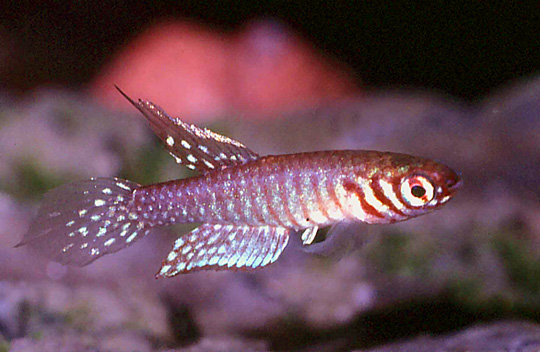
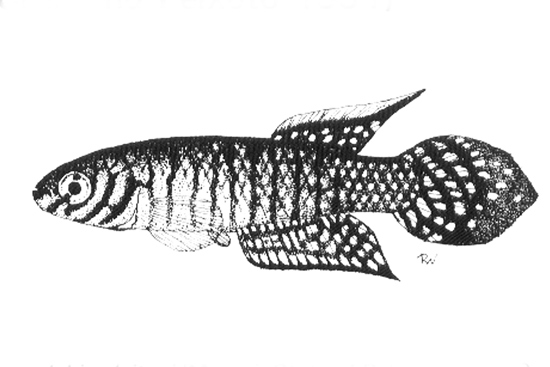
Map
Meristics
Max. size 3.0 cm.
Dorsal 13.0,
Anal 16.0,
D/A 6.0,
LL scale count (average)25.0
Literature
Cruz, C.A.G. da. & O.L. Peixoto. 1992. Descricao de uma nova Especie de Peixe anual do Estado da Bahia, Brasil Cyprinodontiformes, Rivulidae). Revta. Brs. Zool., 7 (4) (1991): 638, fig.
Costa W.J.E.M., 2014. A new genus of miniature cynolebiasine from the Atlantic Forest and alternative biogeographical explanations for seasonal killifish distribution patterns
in South America (Cyprinodontiformes: Rivulidae). Senckenberg, 64 (1): 23 – 33