 Rivulus erberi, Rivulus erberi, |
History
Alternative name Rivulus (Oditichthys) erberi.
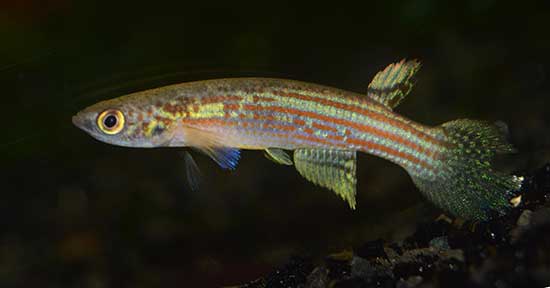
This species was described by Heinz- Otto Berkenkamp in 1989 from a place in Ecuador at the Rio Napo, not far from the type locality of Rivulus limoncochae (Hoedeman 1962). The images to the right were taken from species that were found in the south of Colombia in the upper part of the Rio Putumayo. They were given to me under the name Rivulus spec. "Solita" and Rivulus spec. "Curillo", named after the two small villages they were collected by Daniel Mejia and Harol Sanchez, both Colombian friends. A year after that I went to Colombia and did collect the species myself. I am confident we have Rivulus erberi from these locations at the Putumayo river.


The fish was named after a well known German Killi breeder.
Reproduction
Keeping and breeding is easy but a good cover of the aquarium is necessary because there ability to jump, even true the smallest opening, is unbelievable.
This species can, if there is enough space for them, housed in a tank with more males than one only and several females. If separated before and brought together again however, they can be very agressive to each other and fight to become dominant to others. The best way to have much offspring is to put a pair or an trio in a small tank from 10 liters with a small filter in it or with some airation. On the bottom some peat moss or dark gravel and a floating "mop" to give space for laying there eggs. The fish will, if they become a rich varity of life food, spawn during there whole adult life and produce daily between 5 to 15 eggs.
The eggs should be collected by hand and stored for about 14 days in a small container. Eggs are 1.6 mm and amber colored. It is wise, to add to the water you store the eggs in, some acryflavine to provent fungus coming up.
After hatching the young fry can eat fresh artemia nauplii without any problem. It takes 4 to 5 months to raise them to maturity. Often the number of males is far above the number of females. For some species this can become a major problem for the breeder as he has to raise many young fishes and so become able to distribute a few pairs to other hobbyists. Recent personal tests laerned that lower pH levels during the time of hatching gave a higher percentage of females. To achieve this I use some peat moss that I add to the container with the egss just before they are ready to hatch. This peat moss also is a good way to prevent eggs to become attact by fungusses.
There lifespan can be up to 3 years in captivity.
Remarks :
Variations

Map
Meristics
Max. size 6.0 cm.
Dorsal 7.0,
Anal 13.0,
D/A 10.1,
LL scale count (average)38.0
Pre- dorsal length to % SL – 77.0 %
Depth to % SL – 21.0 %
Literature
Berkenkamp, H.O. 1989. Rivulus erberi spec. nov., ein neuer Bachling aus Equador und Rivulus limoncochae Hoedeman, 1962 (Rivulidae). Das Aquarium (Bornheim), 23 (238): 211, fig.