 Rivulus holmiae, |
History
Alternative name Rivulus (Oditichthys) holmiae.
The history of Rivulus holmiae is short. It was discovered during the expedition from Dr. Carl H. Eigenmann at 21 October 1908 around a village named Holmia located were the Chenapowu River joins the Potaro River above the Kayeteur Falls. This village doesn't excist anymore and only the village Chenapowu some miles further up the Potaro remains. Rivulus holmiae was never reported alive among hobbyists and never an image was taken. Only the b & w drawings in the description are available. And now also the image of the Holotype at the right. (See new hot info below)
The author of this site has travelled over and over again to reach the terra typica but failed always to get there. Transportation above the falls is only possible by small boats from the local indian tribe and this was difficult to achieve due to the fact the people didn't fulfill their promises. Wim Suyker and his travel compagnons managed in 2003 to get there but Suyker was not able to find any other species than Anablepsoides waimacui that is known to that area also.
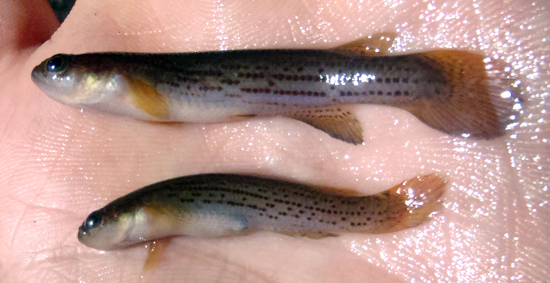
Many species, found in Surinam, northern Brasil and in Guyana itself were called R. aff. holmiae but till today no R. holmiae was found at the terra typica to confirm the relationship between all these species by comparing studies. The image in Killi Data Online from Dr. Huber shows a fish from Marchall Falls in the lower Mazaruni River wich is Rivulus mazaruni from the R. urophthalmus group. The image below shows a species that resembles the R. holmiae in all meristic details. This, and similar species were called Rivulus aff. holmiae by H.H. Hoedeman and L. Seegers as well without proper scientific proof or explanation.

The holotype of Rivulus holmiae shown above was sent to me by the museum in the USA back in 1991 for study. This female with a total length of ca. 76 mm was damaged because 2/3 of the caudal fin was separated from the rest of the sample, obviously teared off by the cover of the bottle it was stored in. To make the image I temporary fused both parts to each other.
For detailed study like DNA- and osteologic study we need more material from the original type locality Holmia or the banks of the nearby Chenapowu River system.
I will try to find this species again in the future to get access to more scientific material for study and to introduce the real Anablepsoides holmiae into the hobby alive and as image.
To do so I have made good contacts to a group of people that look for Diamonds in that region. We agreed they will bring me up if I come again. Perhaps we will succeed than after all the disappointments so far.
HOT : Around the end of the year 2014 a spectecular find was achieved by Dr. Donald Taphorn as he and his team were able to collect this species not too far from the original place it was described from. It also took 106 years to find the species. Unfortunately the collectors did not kept one of the fishes alive for life study later. They stored all in Alcohol .....Dammn !!
Reproduction
Keeping and breeding should be easy but a good cover of the aquarium is necessary because Rivuline ability to jump, even true the smallest opening, is unbelievable.
This species can, if there is enough space for them, housed in a tank with more males than one only and several females. If separated before and brought together again however, they can be very agressive to each other and fight to become dominant to others. The best way to have much offspring is to put a pair or an trio in a small tank from 10 liters with a small filter in it or with some airation. On the bottom some peat moss or dark gravel and a floating "mop" to give space for laying there eggs. The fish will, if they become a rich varity of life food, spawn during there whole adult life and produce daily between 5 to 15 eggs.
The eggs should be collected by hand and stored for about 14 days in a small container. Eggs are 2.0 mm and most likely amber colored. It is wise, to add to the water you store the eggs in, some acryflavine to provent fungus coming up.
After hatching the young fry can eat fresh artemia nauplii without any problem. It takes 4 to 5 months to raise them to maturity. Often the number of males is far above the number of females. For some species this can become a major problem for the breeder as he has to raise many young fishes and so become able to distribute a few pairs to other hobbyists. Recent personal tests laerned that lower pH levels during the time of hatching gave a higher percentage of females. To achieve this I use some peat moss that I add to the container with the egss just before they are ready to hatch. This peat moss also is a good way to prevent eggs to become attact by fungusses.
There lifespan can be up to 3 years in captivity.
Remarks :
The data given in this chapter are estimates for most species of this size but not specific for this species as the species is never kept in captivity.
Variations
Map
Meristics
Max. size 8.0 cm.
Dorsal 10.1,
Anal 17.0,
D/A 12.0,
LL scale count (average)46.0
Pre- dorsal length to % SL – 75.0 %
Depth to % SL – 20.1 %
Literature
Eigenmann, C.H. 1909. Reports on the Expedition to British Guiana of the Indiana University and Carnegie Museum, 1908. Report no. 1. Some new Genera and Species of Fishes from British Guiana. Ann. Carnegie Mus., 6 (1): 50.
The text below was cited from the KilliData - online site of Dr. Jean Huber, France.
Rivulus holmiae and lanceolatus :both cases correspond to fish described by Eigenmann in 1909-1912 that apparently cannot be re-collected despite major efforts in recent years; the description of Riv. holmiae is very good for the beginning of the twentieth century, plus numerous type specimens of both sexes are available in good conditions ; at type locality (near Holmia, at entrance of Chenapowu river, upper Potaro river basin, Guyana (ex British Guiana), 500 m altitude {4.970N;59.580W} ), only Riv. waimacui could be caught ; by morphology, holmiae is close to igneus and to immaculatus ; it differs from igneus by the frontal scalation, the male color pattern and minor morphological characters ; it does not differ from immaculatus except by having a supracaudal ocellus in female (but this is a variable character, like the dark border at male Caudal) ; in addition, holmiae and immaculatus are living in the plateau ; of course both may well not be synonyms, but our thinking is biased by the historical collections in the lowlands of Guyana and Suriname that were identified as holmiae in the sixties and that may be closer to hartii (or to igneus) ; on the other hand, the description of lanceolatus is less obvious and a single type, in poor condition, is available : the unique feature is the "lanceolate" shape of the caudal fin (that cannot be confirmed from the type) ; at type locality (Rockstone, (British) Guiana {5.980N;58.560W} ), only stagnatus-like fish have been collected, yet ; various hypothesis have circulated, including a possible identity as a juvenile Moema sp. that is also reported in the area (apparently ruled out), a possible synonymy with stagnatus (unlikely), a possible synonymy with agilae (then a female specimen) ; no precise argumentation can be forwarded to demonstrate that Eigenmann made a mistake about the type localities or in the descriptions : he stayed in the region several months and as a researcher his reputation is excellent ; then to collect intensively again in the type area of holmiae (or in the region in-between with immaculatus) and to compare the material with the lowlands in Guyana, for the first case, and in the type area of lanceolatus, for the second case, are the only way for better times ...End of citate.