Rivulus mazaruni, |
History
Alternative name Rivulus (Oditichthys) mazaruni.
Myers described Rivulus mazaruni at the hand of material he received from the collector Herbert Lang who collected the species on October 22, 1922.
Myers places the species close to Rivulus urophthalmus. As he sees R. stagnatus as close related to R. urophthalmus he does not compare the R. mazaruni with the R. stagnatus (Eigenmann 1909) that has its terra typica only 80 km far from the place the R. mazaruni was found.
Hoedeman in 1975 than sees a relationship between R. mazaruni and species like R. hartii and R. micropus. This without giving more detailed explanations for this. (Huber 1992)
The habitat was, in a way, not very common for Rivulus as it was described as "putholes" in rocks about 50 km upstream from Kartabo along the Mazaruni River.
However, author of this site was able during one of his many surveys in Guyana to collect in the exact manner Rivulus along the same River at Marchall Falls.
I did not only collect the species in the shallow rainwater putholes, and in the deeper cracks, fully exposed to the sun, in the rocks high above the river waterlevel but also in the nearby forest on a path that was named "Project Road". The Rivulus found there also lived in the smallest waters you can imagen. On the middle of the path some small puddles, containing mostly less than 2 litres of rainwater gave space to several subadult Rivulus.
Rivulus mazaruni was placed in the subgenus Oditichthys, (Huber 1999) and formed a superspecies with: R. caurae. R. cristinae, R. corpulentus, R. cryptocallus, R. deltaphilus, elongatus, R. erberi, R. intermittens, R. iridescens, R. lanceolatus, R. limoncochae, R. lungi, R. micropus, R. ophiomimus, R. peruanus, R. rubrolineatus, R. stagnatus, R. taeniatus, R. urophthalmus and R. xanthonotus.
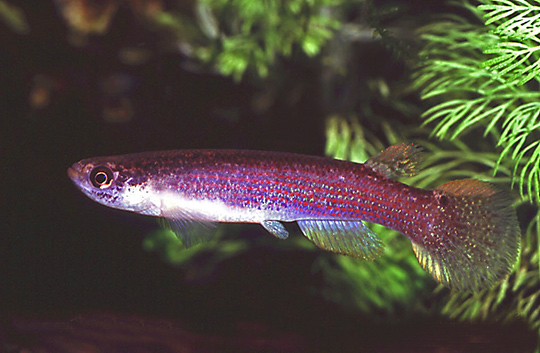
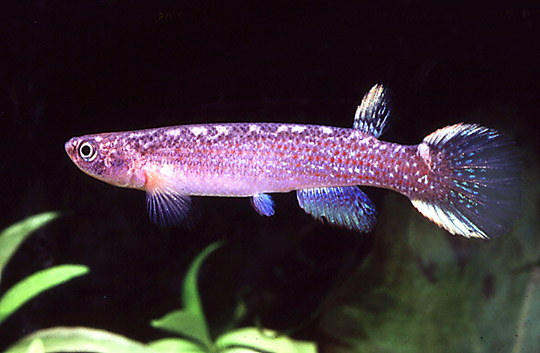
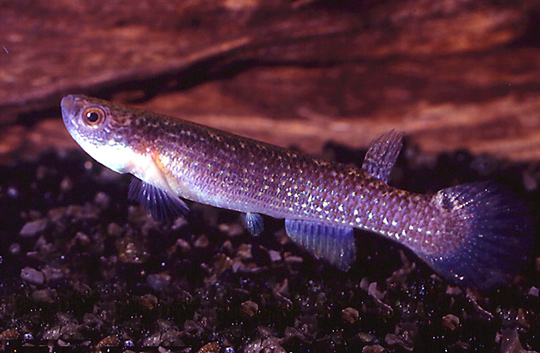
I did visit Guyana 10 times to find Rivulus. During all these visits many varities like this R. mazaruni were collected but all differ also in details like colour of body and fins, meristic measurements and position of the dorsal. Most of them will fit in the description of Rivulus stagnatus and also this species could be a R. stagnatus as well. Others may be new to science.
It is my objective to bring some clearness in the relationship of all the various populations in the guianas but that will be a work of years and the need of crossing experiments and DNA analises. In the mean time I group them all under R. aff. urophthalmus or R. aff. stagnatus. (see those pages in this site)
Reproduction
Keeping and breeding is easy but a good cover of the aquarium is necessary because there ability to jump, even true the smallest opening, is unbelievable.
This species can, if there is enough space for them, housed in a tank with more males than one only and several females. If separated before and brought together again however, they can be very agressive to each other and fight to become dominant to others. The best way to have much offspring is to put a pair or an trio in a small tank from 10 liters with a small filter in it or with some airation. On the bottom some peat moss or dark gravel and a floating "mop" to give space for laying there eggs. The fish will, if they become a rich varity of life food, spawn during there whole adult life and produce daily between 5 to 15 eggs.
The eggs should be collected by hand and stored for about 14 days in a small container. Eggs are 1.6 mm and amber colored. It is wise, to add to the water you store the eggs in, some acryflavine to provent fungus coming up.
After hatching the young fry can eat fresh artemia nauplii without any problem. It takes 4 to 5 months to raise them to maturity. Often the number of males is far above the number of females. For some species this can become a major problem for the breeder as he has to raise many young fishes and so become able to distribute a few pairs to other hobbyists. Recent personal tests laerned that lower pH levels during the time of hatching gave a higher percentage of females. To achieve this I use some peat moss that I add to the container with the egss just before they are ready to hatch. This peat moss also is a good way to prevent eggs to become attact by fungusses.
There lifespan can be up to 3 years in captivity.
Remarks :
Variations
Map
Meristics
Max. size 6.0 cm.
Dorsal 8.0,
Anal 13.0,
D/A 11.0,
LL scale count (average)42.0
Pre- dorsal length to % SL – 79.0 %
Depth to % SL – 18.0 %
Literature
Myers, G.S. 1924. A new Poeciliid Fish of the Genus Rivulus, from British Guiana R. Amer. Mus. Novitates, 129: 1.
Huber, J.H. 1992, Review of Rivulus, Ecobiogeography - Relationships. Cybium, Société Française d'Ichthyologie.