 Rivulus mejiai, |
History
Rivulus mejiai n. spec. is described based on material found at the Eastern Cordillera Andes foothills west of the town Aguazul, Casanare dpt., Colombia.
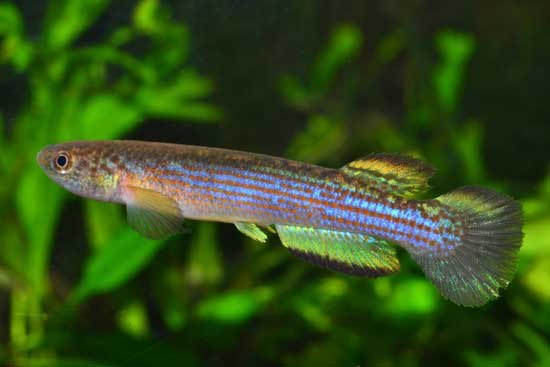
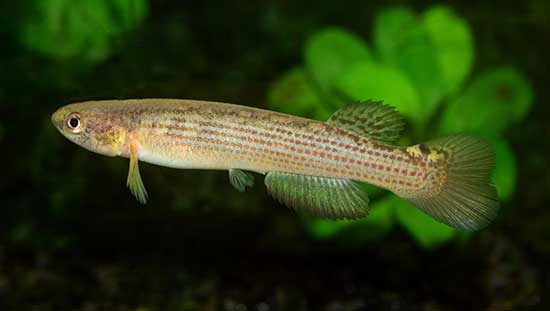
Rivulus mejiai n. spec., was found in a small mountain creek, a tributary to the Unete River. The Rio Unete is one of many rivers that have their source on the Eastern slopes of the Eastern Cordillera, flowing southeasterly to join the Rio Meta and, ultimately the Rio Orinoco system. Rivulus mejiai n. spec. is the only fish species thus far collected from the type locality, a steep, cascading stream with crystal-clear water and strewn with boulders. Like other members of the "Rivulus hartii group," the new species is an excellent swimmer. Rivulus mejiai n. spec. differs from congeners by a series of interrupted horizontal red lines on its purple-blue sides; 7 or 8 of these are visible just posterior to the operculum but they gradually merge into only 3 pronounced lines on the caudal peduncle. Anal, dorsal, and caudal fin ray counts are at the high extremes for the group.
Reproduction
Keeping and breeding are easy, but a tight-fitting cover on the aquarium is necessary because their ability to jump through the smallest opening, is unbelievable.
The type locality is a steep, cascading, primary forest creek with swift current and huge boulders and rocks, providing shelter to the Rivulus. No aquatic plants were present, no other fish species were found in the stream. The water was crystal-clear, with little tannins, and quite cold at about 20 degrees Celsius. (68 degrees Fahrenheit). No other data were recorded. Fish were initially visible in the clear water midstream but quickly fled to cracks and cavities inaccessible to nets. Most specimens that we were able to collect were semi-adult or juveniles.
[Rivulus mejiai can live up to 4 years, possibly even longer, in aquaria, and adults can reach a total length of at least 67.8 mm under aquarium conditions. Females behave aggressively to males in the aquarium, leading to severe fin damage or even death if sufficient hiding places are not provided. Eggs are amber-colored and 2.5 to 3 mm in diameter.
The best way to produce fry numbers is to put a pair or a trio in a small tank of about 10 liters with a small filter in it or with some aeration. Cover the tank's bottom with some peat moss or dark gravel and put a floating "mop" on top to give a place for laying their eggs. If they are fed a rich variety of live food, the fish will spawn during their whole adult life and produce daily between 5 to 10 eggs.
The eggs should be collected by hand and stored for about 14 days in a small container. Eggs are 1.6 mm and amber-colored. It is wise to add an anti-fungus to the water you store the eggs to prevent fungal attacks.
After hatching, the young fry can eat fresh artemia nauplii without any problem. It takes 4 to 5 months to raise them to maturity. Often the males far outnumber females. For some species, this can become a significant problem for the breeder, as he has to raise many fries to enable distribution of a few pairs to other hobbyists. Recent personal tests found that lower pH levels during hatching gave a higher percentage of females. To achieve this, I used some peat moss to add to the container with the eggs just before they were ready to hatch. This peat moss also is an excellent way to prevent eggs from being attacked by fungus.
Remarks :
This species is not distributed in the hobby yet but eggs may be available in the beginning of 2021. Eggs do need 2-3 weeks for full development and shipping is tricky if it is to Asian countries or othert countries at long distances from Aruba.
Variations
Map
Meristics
Max. size 0.0 cm.
Dorsal 00.0,
Anal 00.0,
D/A 0.0,
LL scale count (average) 00.0
Pre- dorsal length to % SL – 00.0 %
Depth to % SL – 00.0 %
Literature