 Rivulus taeniatus, |
History
Alternative name Rivulus (Oditichthys) taeniatus.
The type locality of Rivulus taeniatus is Morelia, río Caqueta drainage, southern Colombia.
The species was discovered by Kjel von Sneidern in October 1940. The unique holotype is stored at ANSP (philadelphia) with # 71720 and is a male of 36.9 mm S.L..
Following Costa is Rivulus taeniatus living in a wide range of the Amazon basin, not only in the Colombian part but also the rivers Solimoes and Rio Branco.
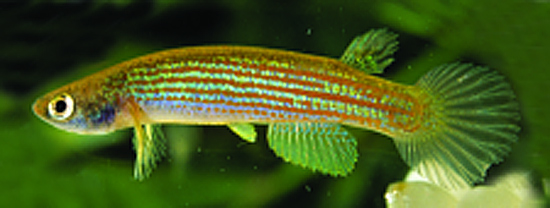
I went to the type locality myself in 2006, a small town in southern Colombia with the name Morelia. We found Rivulus taeniatus at its type locality just outside the town in great numbers in a small brook at the side of the road where they were te only species and were not hiding but visable in the clear stream.. As you can see the fish has fine lines on the sides not fusing"" or "fading" towards the caudal peduncle as so many species from the Superspecies they belong to.
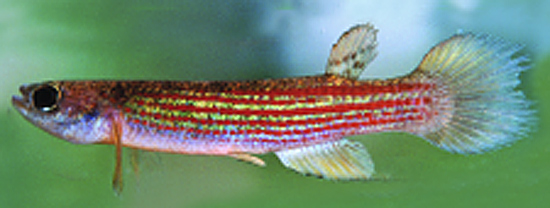
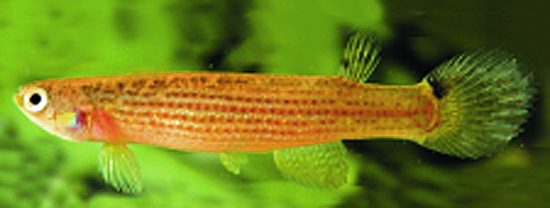
The photos provided by Costa from Amazonas Dpt., Brazil"" and Rio Branco, Brazil"" do not have same coloration and pattern and may be undescribed taxa.
Unfortunately Costa did not study the original material of Rivulus taeniatus from its type locality and based his outcome in his paper in 2006 on wrong- or insufficient data.
Superspecies components are:
R. bahianus, R. caurae, R. cearensis, R. chapare, R. christinae, R. corpulentus, R. cryptocallus, R. deltaphilus, R. elongatus, R. erberi, R. falconi, R. hoetmeri, R. intermittens, R. iridescens, R. jari, R. katukina, R. lanceolatus, R. limoncochae, R. lineasoppilatae, R. luitalimae, R. lungi, R. mazaruni, R. micropus, R. ophiomimus, R. parlettei, R. peruanus, R. roraima, R. rubrolineatus, R. stagnatus, R. taeniatus, R. tocantinensis, R. urophthalmus, R. urubuiensis, R. xanthonotus and R. xinguensis.
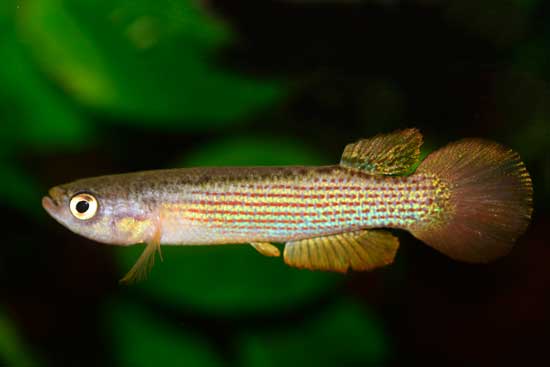
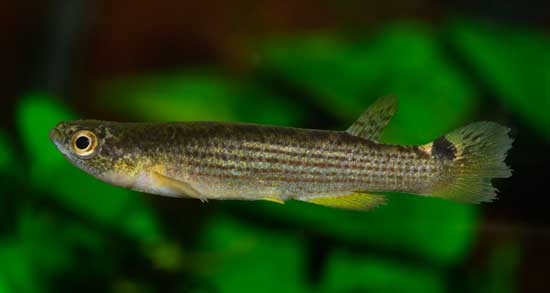
Below some images of "R. taeniatus" provided by Costa in his work Relationships and taxonomy of the killifish genus Rivulus
(Cyprinodontiformes: Aplocheiloidei: Rivulidae) from the Brazilian Amazonas
river basin, with notes on historical ecology"" from 2006.
In this very large and impressive work Dr. Wilson Costa tried to create clearness in the large number of species that live in the branches of the Amazon river. Because of the history of the Amazon and its reversed flowdirection by the uplift of the Andes and temporarily inundation with marine water million of years ago during Ice Ages. The overlapping and patched distribution limits of the various species is far from easy to understand and document and it may be impossible to separate one species from the other based on meristics, Osteology and appearance only.
A wide array of DNA sequencing may bring some light in the darkness for this group if fishes.
Reproduction
Keeping and breeding is easy but a tight fitting cover on the aquarium is necessary because their ability to jump, even through the smallest opening, is unbelievable.
This species can, if there is enough space for them, be housed in a tank with more than one male and several females. If separated before and brought together again however, they can be very aggressive towards each other and fight to become the dominant fish. The best way to produce numbers of fry is to put a pair or a trio in a small tank of about 10 lit res with a small filter in it or with some aeration. On the bottom of the tank place some peat moss or dark gravel and a floating "mop" to give space for laying their eggs. The fish will, if they are fed a rich variety of live food, spawn during their whole adult life and produce daily between 5 to 15 eggs.
The eggs should be collected by hand and stored for about 14 days in a small container. Eggs are 1.6 mm and amber colored. It is wise to add an anti fungus to the water you store the eggs in, to prevent fungal attacks.
After hatching the young fry can eat fresh artemia nauplii without any problem. It takes 4 to 5 months to raise them to maturity. Often the males far out number females. For some species this can become a major problem for the breeder, as he has to raise many fry to enable distribution of a few pairs to other hobbyists. Recent personal tests found that lower pH levels during the time of hatching gave a higher percentage of females. To achieve this I used some peat moss that I added to the container with the eggs just before they were ready to hatch. This peat moss also is a good way to prevent eggs from being attacked by fungus.
Their lifespan can be up to 3 years in captivity.
Remarks :
Variations
Map
Meristics
Dorsal 8.0,
Anal 14.0,
D/A 10.1,
LL scale count (average) 37.0
Pre- dorsal length to % SL – 77.0 %
Depth to % SL – 21.0 %
Vertebrae count (average) 31
Literature