 Orestias ispi, |
History
The name of Orestias ispi is derived from the local name for this fish as fishermen call them locally "Ispus".
The type locality is found in the lesser Lake Titicaca in North West Bolivia. No synonymes are given for this species but it can easily be mistaken for juvenile O. petlandii and is distinguished from that species by its lower number of vertebrae (31-33 versus 36-38).
The common english name for O. ispi is: " Thinscaled Mountain Killi.

It fit's in the Orestias curvieri species group and belongs to the smallest members within the Orestias genus. The species florish and dwells in large schools along the shores of Lake Titicaca. Due to the introduction of trouts in the early sixties as fish for foodconsumpition their numbers increased, possible as result of the predation by trout on Orestias cuvieri, that was the natural predator of this smaller Orestias.
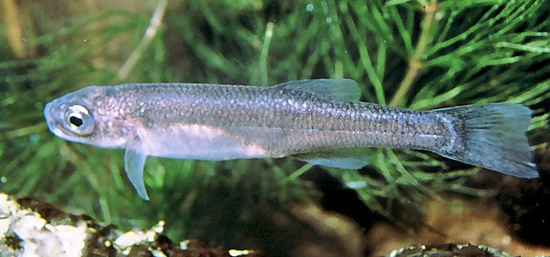
Orestias ispi is also a small member of the genus that has the whole body covered with small thin and irregularly distributed scales and a stronly upward directed mouth whch suggest that their source of food can be found at the surface. They feed mainly on mosquito larvae.
As in many other species these fishes don't show much difference in sexes as they are juveniles. Color is silvery gray. Dorsal area is more dark. Fins are clear to very pale gray.

Reproduction
Members of this genus have been generally maintained and bred only under controlled laboratory conditions rather than as aquarium fishes. Therefore, information about maintainance and breeding is present here as part of the general information about the genus rather than under each individual species. This information is based mainly on that obtained in the laboratory of the zoological Institute and zoological Museum, Hamburg (Villwock, 1995b)
Keeping and breeding Orestias species in captivity requires that the water is relative cool with temperatures between 10 and 15 C. Optimal water temperatures would be about 13 C.
Today it is believed that the species from the genus Orestias reach sexual maturity when they still display juvenile coloration and morphology. At that stage it is very difficult to recognise the sexes.
Eggs are deposited one by one or in a small cluster in fine substrate like live plants with fine leaves. Development of the eggs takes about 4 weeks due to the low temperatures the eggs should be stored. Youngs grow slow and can be fed by artemia nauplii and small worms and crustaceans
Remarks :
Because this special treatment the genus Orestias is seldom found in the tanks of hobbyists.
Source:
R. Wildekamp, "A world of Killies" , Volume 4.
Variations
Map
Meristics
Max. size 7,5 cm.
Dorsal 11-16,
Anal16-19,
LL scale count 41-53
Literature
Morales, P., Gajardo, F., Valdivieso, C. et al. Genomes of the Orestias pupfish from the Andean Altiplano shed light on their evolutionary history and phylogenetic relationships within Cyprinodontiformes. BMC Genomics 25, 614 (2024).
https://rdcu.be/dOnkA