 Rivulus sladkowskii, |
History
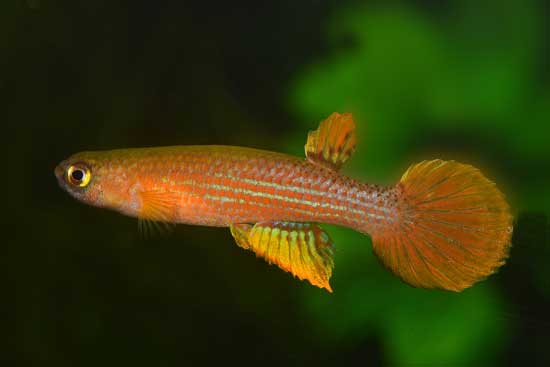
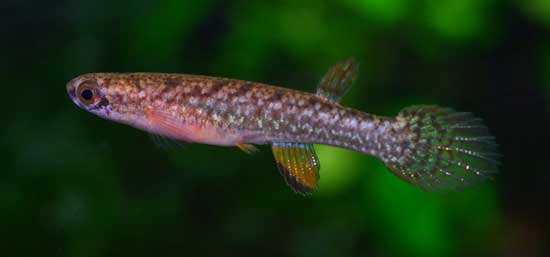
This article describes Rivulus sladkowskii n. spec. from Mitú, a small village along the headwaters of the Vaupés River, eastern Colombia, based on external and internal anatomical-morphological characteristics. This species belongs to the subgenus Owiyeye, member of the Rivulus romeri species group. The Vaupés River is an important source of the Rio Negro, a tributary of the Amazon River. The new species belongs to a group of miniature Rivulus but differs from its group members by body and fin coloration, body pattern, and to some extent, fin shape. Unlike its group members, which occur only in shallow water bodies such as swamps filled with leaf litter, this species is also found on the banks of small creeks and the mouths of larger creeks, where there is a moderate current. They seek shelter and reproduce in thick layers of leaf litter on the creek banks. Current members of the Rivulus romeri species group and the Rivulus rectocaudatus species group are discussed and compared.
Named to honor the well-known German Killifish expert, and regular travel companion of the author, Siegmund Sladkowski, born October 8, 1935 in Königshütte, Germany, residing in Wilhelmshaven, Germany, who is specialized in breeding and propagating this group of small Rivulus. The author wishes, in this way, to thank him for his great friendship over the last 45+ years.
Reproduction
Keeping and breeding is not easy, the species needs special attention and is for the practiced killi keeper, and a tight-fitting lid on the aquarium is necessary because their ability to jump, even through the smallest opening, is incredible.
This species can, if there is enough space for them, be housed in a tank with more than one male and several females. If separated before and brought together again however, they can be very aggressive towards each other and fight to become the dominant fish. The best way to produce numbers of fry is to put a pair or a trio in a small tank of about 10 to 15 litres with a small filter in it or with some aeration. On the bottom of the tank place some peatfibre, peatmoss or dark gravel and a floating "mop" to give space for laying their eggs. The fish will, if they are fed a rich variety of live food, spawn during their whole adult life and produce between 1 to 5 eggs daily. The adults do not chase and eat their youngs so it is possible to raise the fry in the tank with the adult fish.
The eggs should be collected by hand and stored for about 14 to 21 days in a small container. Eggs are 1.5 mm and clear to amber coloured. It is wise to use pure rainwater for storing te eggs and add an anti fungus to the water you store the eggs in, to prevent fungal attacks.
After hatching the fry can eat fresh artemia nauplii without any problem. It takes 4 to 5 months to raise them to maturity. Their lifespan can be up to 3 years in captivity.
Remarks :
If the eggs are in a state close to hatching, they are sensitive to pressure and it is wise not to touch them in that state.
This species loves to be held in clean rainwater and prefers pH values around 5,5 to 6,5 pH. Temperatures of around 23 Celsius is best. Do not keep them above 25 Celsius because egg producyion slows down..
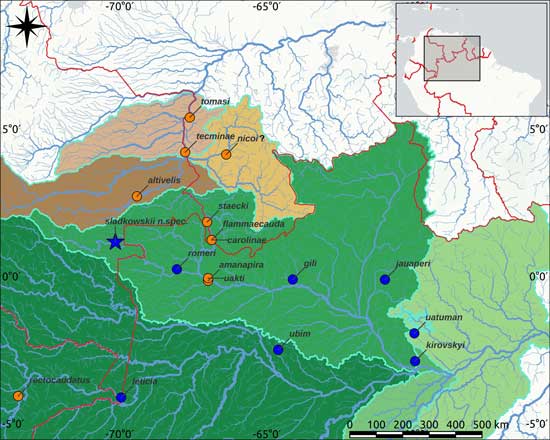
The species is found originally in Mitú along the upper Vaupes River in Colombia. This river contignues in Brazil and is named Uapés in that country. But similar species were captured during several other collecting trips by me in the Taraira River, the lower Caquetá River and Apaporis, near La Pedrera. These locations show other colors and we need to investigate if this are variants or represent a different taxon.
Variations
Map
Meristics
Max. size 21.9 mm. SL.
Dorsal 6.8,
Anal 9.0,
D/A 5.9,
LL scale count (average) 29.6
Pre- dorsal length to % SL – 72.6 %
Depth to % SL – 12.5 %
Literature