 Pituna obliquoseriata, |
History
The type locality of this new species is situated 15 to 16 Km. from the right bank of the Rio das Mortes along the road MT-326, Rio Araguaia basin, Estado de Mato Grosso, Brasil. The species was discovered by W. Costa, G. Brasil, M. Landim and C. Moreira on 16 february 1996.
It is distinguished to other members of the Pituna genus by having higher number of caudal finrays and other characters like higher number of scales LL 25 - 29 versus 23 - 24, and for example oblique arranged spots on female flanks versus irregularly or longitudinally arranged spots in other species.
This feature is also the explanation for the choosen name Pituna obliquoseriata (= oblique) and seriata (= with series).
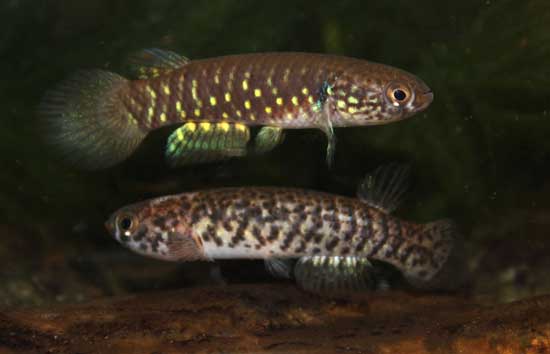
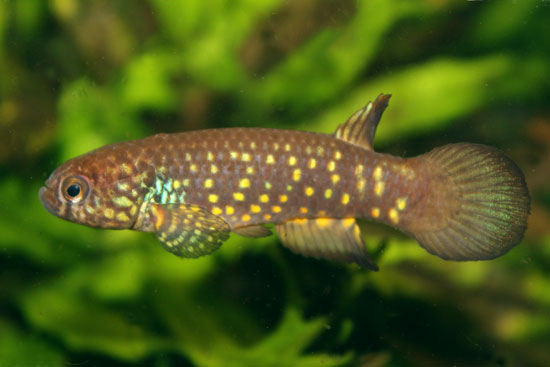
Largest species examined was an male of 37.5 mm Standard Length but I assume they grow bigger reaching adulthood.
Reproduction
The genus Pituna has a slightly different way of spawning than Rivulus do and a complete different way than most Annuals do. They spawn abóve the substratum and eggs have no sticky filaments on the cambium (egg-shell). No records of diving in the bottom or plowing against the bottom so far. Eggs are about 1.7 mm in diameter and clear- to amber coloured. The incubation period can take 12 weeks up to 20 weeks. To be sure the eggs are ready to hatch we must check regulary with intervals of, at the most, 2 weeks. If eggs are eyed up (the iris becomes clearly visable) the peat is put in a shallow dish with water to let the fry emerge. You can feed artemia the first day. A day after the fry is swimming I pore the water including the youngsters over into a bigger tank and re-dry the peat for a week or 2 and wet it again.
Members of the genus Pituna love acid water with pH of 4,5 to 6. They can stand bad water quality for a certain time but this will interrupt any spawning activity.
The set- up for the breeding tank needs extra attention to. Pituna can jump like Rivulus do (perhaps not as often) and a good cover is nesessary. Males can be very agressive to each other and kill. It is not recommended to put more than one male in a breeding tank. Putting more females in the breeding tank is advisable due to the constantly sexual driving of the male that can harm the females. Give also a lot of hiding places into the tank, esspecially when it is smaller than 60 liters content. I use for that purpose mops, plants and additional small pvc pipes where females can seek shelter.
Pituna is a nice, but in the hobby seldom seen, fish. Only the real hobbyist will find a way to lay his hand on these beauties and it will take some extra attention to keep them over a longer period of time and to multiply enough of them to distribute the species among other hobbyists.
Variations
Map
Meristics
Max. size SL 37.6 mm.
Dorsal 9 - 10,
Anal 13 - 15,
D/A 9 - 10,
LL scale count : 27 - 29
Pre- dorsal length to % SL – 72.3 %
Depth to % SL – 23.1 %
Literature