 Plesiolebias canabravensis, Plesiolebias canabravensis, |
History
This small and fragile species of the genus Plesiolebias was discovered in an temporary lagoon, left Rio Canabrava floodplains, Santa Tereza drainage, Rio Tocantins basin along road TO-733 between Alvorada and Peixe, on 292 altidude. The discoverers W. Costa, C. Bove, J. Paz and A. Oliveira, found the species on 16 April 2006 for the first time.
Visually the species differs from the other species in Plesiolebias by having an red stripe on anterior portion of the flanks, reaching the eye in males (versus not reaching the eyes), the absence of oblique bars on sides in males (versus the presence of dark bars.) Male do not show black markings in the anal fin (versus fin with black markings or spots) Female image in description do not show oblique dark bars (versus bars on flanks) but only show some dark dots on the middle section of the body.
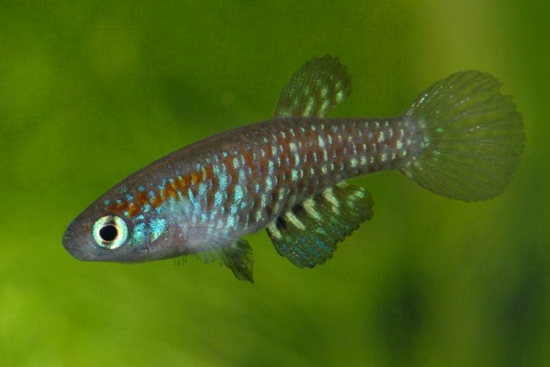
The species is named after the rio Canabrava floodplains from where it was found.
The habitat is an seasonal lagoon in savannah area, near rio Canabrava, rio Tocantins basin, Brasil.
The species was not introduced into the hobby yet.
Reproduction
Breeding all members of the Plesiolebias family is for experienced hobbyists only. The eggs need a long incubation period of sometimes 6 to 9 months and are very mall compared to the most other annual fishes. The young fry need absolute infusoria to eat in the fist weeks of their life. Growing to maturity is under good circumstances very quick and within 2 months Plesiolebias is able to reproduce already. This is my expirience but I am aware of other written articals that state this will be more. Slow growth could be triggered by insufficient food in the first weeks of their life.
Production of eggs is abundant but the outcome gives mostly not a good rate in gender and often males are 90 % or more in the offspring what makes it difficult to spread the fish otherwise than by sending eggs. As the members of the genus are also easely stressed it is not easy to send or transport these delicate fishes also.
For every hobbyist that has a special interest in this genus therefore it is a challenge to keep and reproduce them over a longer period of time.
Remarks :
The fry are very small and need to be fed with paramecium or other micro organisms. The use of a bunch of plants in the breeding container also will help the fry to feed for the first days. After one or two weeks fresh artemia can be eaten.
Variations
Map
Meristics
Max. size SL 17.2 mm.
Dorsal 9-10,
Anal 14-16,
D/A 7-8
LL scale count (average)23-24
Pre- dorsal length to % SL – 68.5 %
Depth to % SL – 28.3 %
Literature