 Plesiolebias xavantei, Plesiolebias xavantei, |
History
Plesiolebias xavantei was described as Cynolebias xavantei in the year 1988. It was later in 1995 placed in the than new erected genus Plesiolebias and became the type species of this genus.
This minute species with deep- body profile can be found in temporary pools and swamps around the floodplanes of the middle Tocantins River in the state Tocantins, central Brazil.
The name xavantei refers to the most important or largest Amerindian tribe from the region where the species was discovered.
Note:
Special thanks to Ulysses Fernandes who made the photos on request special for this site and did shared them with us. Thank you Ulysses.
If you as one of vistitors have good images like these of species not showed in my pages, please contact me and share your photos with the community as well.
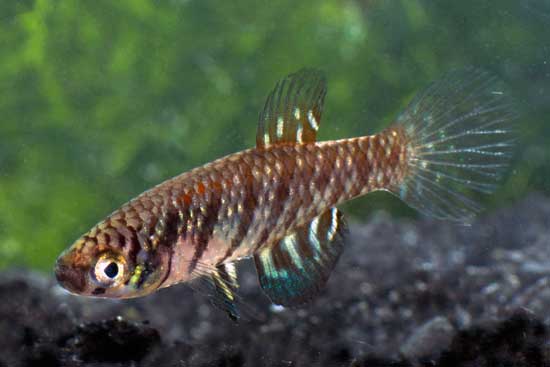
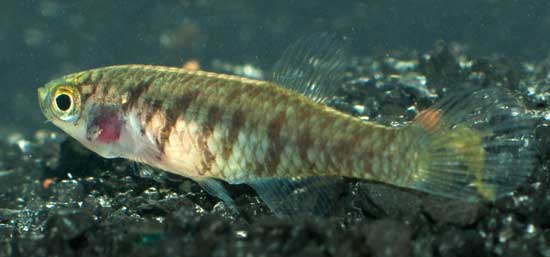
Colors in life:
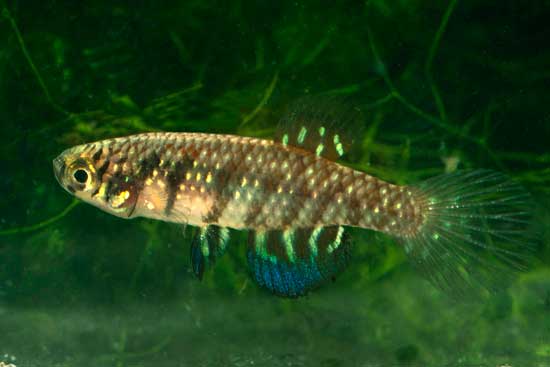
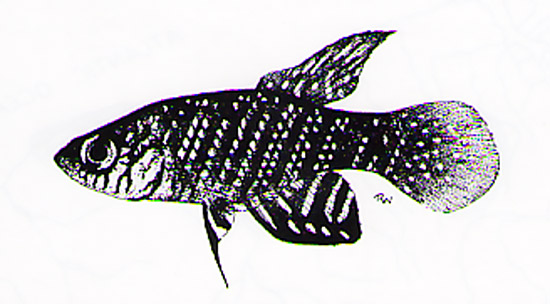
Male: See the images above. The sides are purple- brown with eleven or twelve dark brownish red, oblique crossbars. The lower parts of the most anterior bars are almost black. Between these crossbars there are rows of pale blue spots. On the upper half on the body, extending from the opercula to the beginning of the dorsal fin, there is a row of dark red scales. Dorsal fin purple, grading to almost blach to its margin. The anal fin is similar in color but the blue spots are larger and the pattern differs.
Female: Females have also about twelve oblique bars on a light brown body. Un-paired fins hyaline.
Source: A World of Killies, band 4, page 374, by R.H. Wildekamp. AKA published.
Reproduction
Breeding all members of the Plesiolebias family is for experienced hobbyists only. The eggs need a long incubation period of sometimes 6 to 9 months and are very mall compared to the most other annual fishes. The young fry need absolute infusoria to eat in the fist weeks of their life. Growing to maturity is under good circumstances very quick and within 2 months Plesiolebias is able to reproduce already. This is my expirience but I am aware of other written articals that state this will be more. Slow growth could be triggered by insufficient food in the first weeks of their life.
Production of eggs is abundant but the outcome gives mostly not a good rate in gender and often males are 90 % or more in the offspring what makes it difficult to spread the fish otherwise than by sending eggs. As the members of the genus are also easely stressed it is not easy to send or transport these delicate fishes also.
For every hobbyist that has a special interest in this genus therefore it is a challenge to keep and reproduce them over a longer period of time.
Remarks :
The fry are very small and need to be fed with paramecium or other micro organisms. The use of a bunch of plants in the breeding container also will help the fry to feed for the first days. After one or two weeks fresh artemia can be eaten.
As far a I did know, this species was not reported available in the hobby till recently (March 2019).
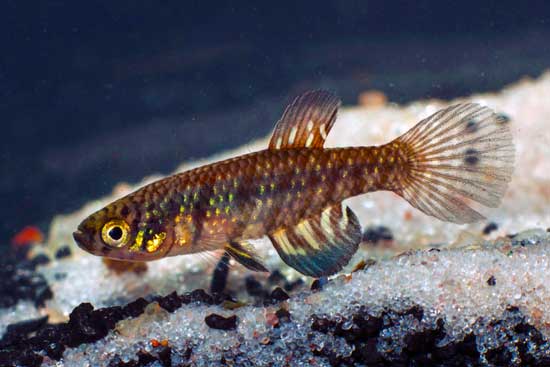
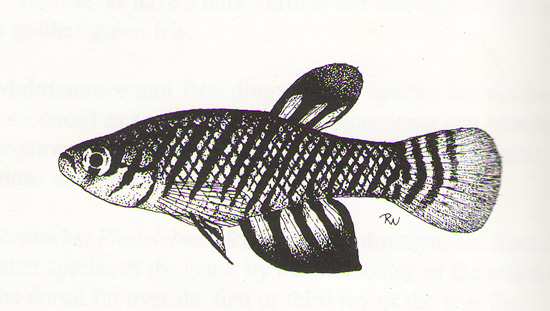
Variations
Map
Meristics
Max. size 3.0 cm.
Dorsal 12.0,
Anal 16.0,
D/A 5.5,
LL scale count (average)23.0
Pre- dorsal length to % SL – 62.0 %
Depth to % SL – 24.5 %
Literature
Costa W.J.E.M., M.T.C. Lacerda & K. Tanizaki. 1988. Description d'une nouvelle Espece de Cynolebias de Bresil central (Cyprinodontiformes, Rivulidae) Rev. fr. Aquariol. Herpetol., 14 (1987) (4): 123, figs. 1-8.
Costa, W.J.E.M. 2007. Taxonomy of the plesiolebiasine killifish genera Pituna, Plesiolebias and Maratecoara (teleostei: Cyprinodontiformes: Rivulidae), with descriptions of nine new species. Zootaxa 1410: 21.