 Simpsonichthys espinhacensis, |
History
A new species of Simpsonichthys is described from the upper rio Jequitinhonha basin, Minas Gerais, eastern Brazil. It is diagnosed from all congeners by presenting an A-patterned frontal squamation. Additionally, males of the new species differ from all congeners by the color pattern of body, the color of iris, the absence of contact organs in the pectoral fin, presence of scales on anal-fin base, pectoral-fin length, caudal fin length, and eye diameter. Females of the new species can be diagnosed from remaining congeners by the pectoral-fin length. The conservation status of the new species is evaluated. Comments on the relationships of the new species within the genus Simpsonichthys are presented. The genus Simpsonichthys Carvalho was described based on a beautiful reddish-colored fish collected by an employee of the Brasilia Zoo in 1958. He took the specimens to the director of the Zoo, at that time Mr. José Boitone, who in turn sent them to the ichthyologist Antenor Leitão de Carvalho, who published the description of a new genus and species, Simpsonichthys boitonei, in the following year (Carvalho, 1959). A feature of the then newly described taxon that intrigued Mr. Carvalho was the absence of pelvic fins, which lead him to erect the genus Simpsonichthys to allocate the newly described species (Nielsen, 2008). Posteriorly, the genus was considered as a junior synonym of Cynolebias Steindachner, then diagnosed by the absence of scales on the caudal-fin and the absence of preopercular canal (Parenti, 1981). That synonymy perdured until Costa (1996), who recognized Simpsonichthys as valid genus, and presented a hypothesis of phylogenetic relationships among the species known at the time. Two years later, Costa (1998) proposed the sub-tribe Simpsonichthyina to include Simpsonichthys and Nematolebias Costa.
The systematics of Simpsonichthys was revised by Costa (2006, 2007), which recognized five subgenera and 50 valid species. Three years later, all subgenera were raised to the generic level and Simpsonichthys was restricted to, at that time, eight valid species (Costa, 2010). These species are distributed throughout the central Brazilian plateau at Upper Paraná, Upper Araguaia and Upper São Francisco river basins (Costa, 2007).
Costa (2010) proposed two clades for the genus, a western clade including S. cholopteryx Costa, Moreira & Lima, S. margaritatus, Costa, S. nigromaculatus Costa and S. parallelus Costa, occurs in upper rio Araguaia and the upper tributaries of the rio Paranaíba; and an eastern clade that includes S. boitonei, S. punctulatus Costa & Brasil, S. santanae (Shibatta & Garavello) and S. zonatus (Costa & Brasil) which occur at the upper tributaries of the western rio São Francisco basin and tributaries of the upper rio Paraná basin.
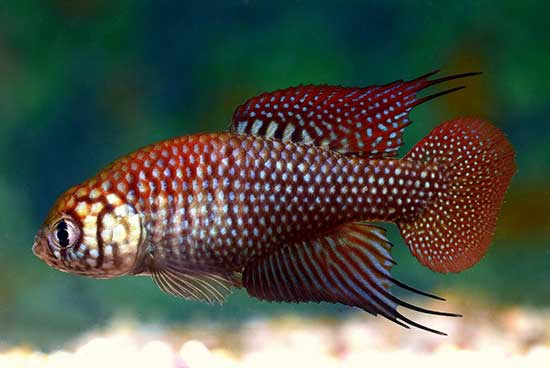
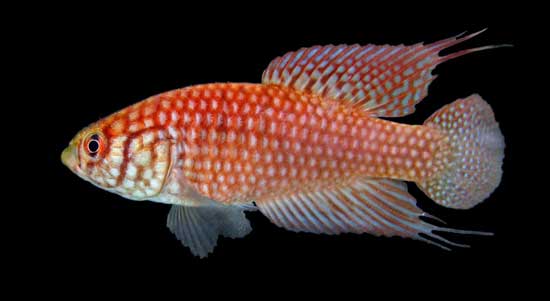
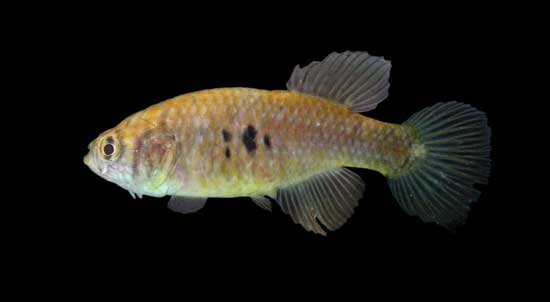
More recently, the monophyly of Simpsonichthys was questioned by a molecular phylogenetic analysis in which S. margaritatus Costa and S. parallelus Costa were recovered as more related to Spectrolebias Costa & Nielsen than to Simpsonichthys punctulatus Costa & Brasil (Ponzetto et al., 2016). Recent field expeditions to the headwaters of rio Jequitinhonha basin in Minas Gerais State, eastern Brazil, yielded a previously unknown species of Simpsonichthys which is described herein. Information on its conservation status is also provided.
Distribution and habitat.
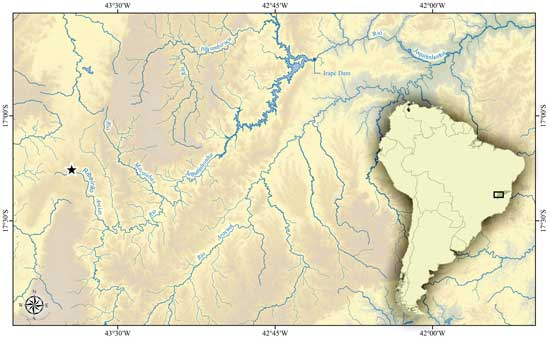
Known only from Vereda Volta da Capoeira and Ribeirão da Areia, headwater tributaries of the Rio Jequitinhonha basin, Minas Gerais state, Brazil . These are large flooded areas during the rainy season. During this time of the year, water is relatively cold (24.6– 26.9 C.), with pH ranging from 6.46 to 7.38, electric conductivity 0.04 to 0.47 mS/cm, and water salinity 0.02 to 0.23 ppt. The soil is hydromorphic with a thick layer of organic matter. During the dry season, the wetland is reduced to small pools and intermittent channels (Fig. 4C). The wetlands are dominated by herbaceous and grassy vegetation, with buriti palms (Mauritia flexuosa).
Info taken from the original descryption.
Reproduction
The care and breeding of species of the genus Simpsonichthys is for advanced enthusiasts. Propagation is not the only thing that needs extra attention. First, it is not easy to purchase the species because these species are rarely offered. Simpsonichthys are fish that deposit their eggs piece by piece by diving deep into the substrate. They are moderately productive and their eggs generally have an incubation period of 2,5 to 3 months at a storage temperature of 25 to 28 C. However, it is advisable to check at an earlier date for eggs that develop before then. Experience of some breders has shown that eggs are ready to hatch even after 5 to 6 weeks. In some species the developed eggs are very dark in color and therefore it is difficult to see the iris inside the egghull and that makes it difficult to see what state the eggs are in.
Always try out just a few of the eggs before putting all the peat in the water. Such a test is necessary to recognize if the hatchlings will not remain belly sliders and thus will swim well.
It is best to use rainwater because Simpsonichthys is sensitive to calcium-rich water. The best temperature for watering is 18 to 20 degrees Celsius. The young are relatively large when they hatch because their eggs are also quite large. They can eat Artmia immediately after hatching and after a few weeks also much larger live foods such as sieved Daphnia. After 6 weeks the youngsters are already able to produce the first eggs. Their life expectancy in captivity can reach up to 1.5 years. But in nature they do not live long because their pool goes dry after 7 to 8 months.
Remarks:
A breeder I know indicated that breeding Simpsonichthys margaritatus benefited from floating plants above where they come to deposit. This can of course also be the case with the other species of the genus Simpsonichthys.
Variations
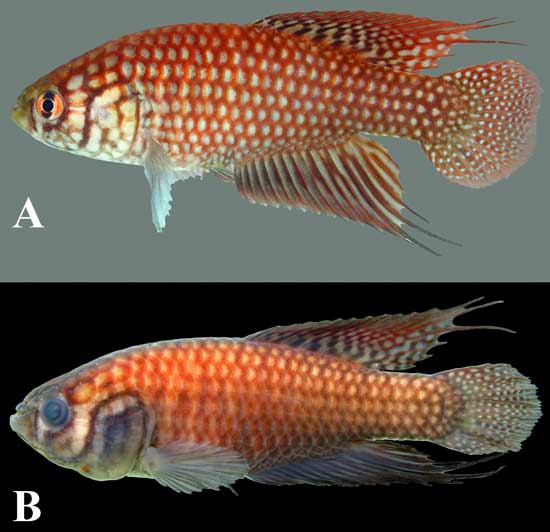
Male, (A) alive and (B) preserved. Brazil, Minas Gerais
State, Vereda Volta da Capoeira, Rio Jequitinhonha basin.
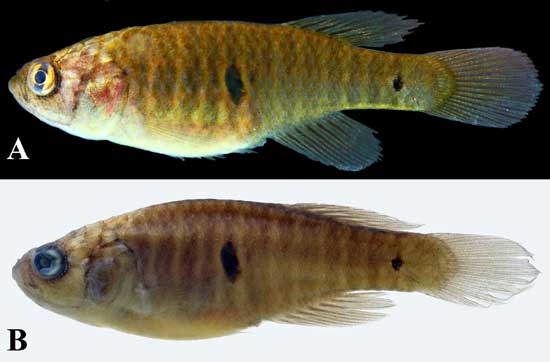
Female, (A) alive and (B) preserved. Brazil, Minas Gerais
State, Vereda Volta da Capoeira, Rio Jequitinhonha basin.
Map
Meristics
Max. size 45.7 mm.
Dorsal 16-18 in males, 14-18 in females.
Anal 16-19 in male, ? in females.
D/A -.,
LL scale 25-28
Pre- dorsal length to % SL. 57.7 %
Depth to % SL – 31.8 %
Literature
Nielsen D.T.B., T.C. Pessali and G.M. Dutra, 2017. A new annual fish of the genus Simpsonichthys (Cyprinodontiformes: Cynolebiidae) from the upper Rio Jequitinhonha basin, Brazil. Zootaxa 4263 (1): 165–172.
killifish genus Simpsonichthys
(Teleostei: Cyprinodontiformes: Aplocheiloidei: Rivulidae) Zootaxa 1669: 1–134.