 Simpsonichthys margaritatus, |
History
This species was described as Simpsonichthys margaritaus.
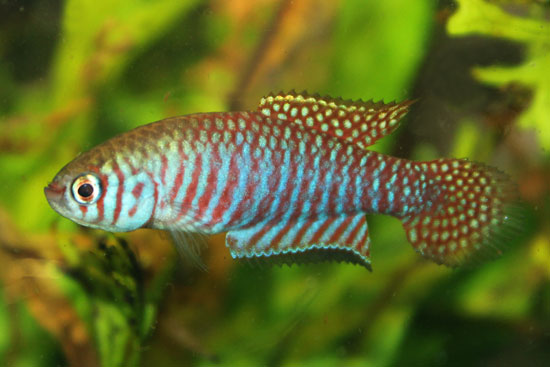
Etymology: with pearls (from Latin : margaritatus), in reference to the color pattern of male dorsal and caudal fins, with small light spots arranged in close proximity, remembering pearl collars.
Superspecies-components:
Simpsonichthys boitonei, cholopteryx, espinhacensis, margaritatus, nigromaculatus, parallelus, punctulatus, santanae, zonatus.
Type locality road GO-184, Municipio de Serranópolis, Goiás, Brasil. Coord. 18°22'30.22"S 52° 0'57.94"W
About the type locality:
types unexpectedly collected during peak of dry season of region (September), although only 4 specimens are found after some hours of intensive efforts to sample habitat by 6 persons ; in this region of Brasil, single annual rainy season is concentrated between October and April ; in a first visit to that region (January 2004), when only a non-seasonal Rivulidae is found, entire marginal area of Verde River is flooded, leaving no isolated temporary pools, the typical annual killifish habitat (shallow seasonal pools) (Costa, 2012a). (Source: KilliDataOnline.)
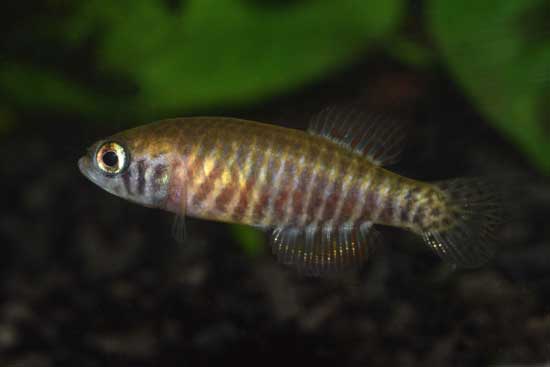
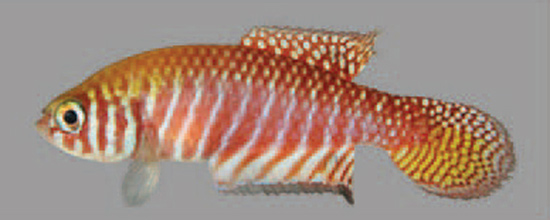
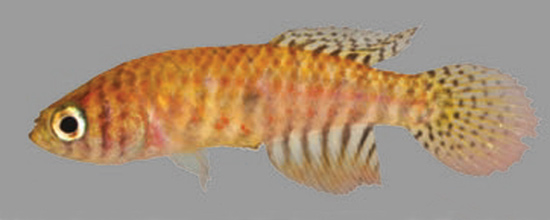
Simpsonichthys margaritatus is described from the Verde River floodplains, upper Paraná River basin, central Brazil. It is distinguished from all other congeners by having series of small light blue to light yellow spots arranged in close proximity on the dorsal and caudal fins in males and oblique dark brown bars on the anal fin in females. It is member of a clade including miniature species endemic to an area of central Brazilian high plateaus drained by .
rivers connected to the lower section of the Paranaíba River and adjacent upper tributaries of the Araguaia River The new species seems to be more closely related to S. cholopteryx, from the upper Araguaia River basin, by both having oblique red bars on the anal fin in males
Diagnosis: distinguished from all other related components by the presence of small light blue spots in close proximity to form vertical series on dorsal and anal fins of male. (Costa, 2012a).
Reproduction
This species seems difficult in reproduction and need some extra attention during the first days as they need very small food as just hatched artemia or even better infusorians. The big challenge is to find the best temperature for storing the eggs. Temperatures are not much higher in the habitat of Simpsonichthys margaritatus than were other species occur....and soil is also built up out of clay. So....why the species need high temperatures to develop is not easy to tell. It could be possible they lay their eggs not very deep into the soil and the sun is warming up that layer more than in other places. Perhaps we need to get more info out of scientific set-ups with different conditions like pH, temperature and moistness of the medium.
The way they spawn is, as most annual species do, by diving completely into the substratum. This is best placed in a small jar or drinking glass at the bottom, filled with peat moss from at least the depth of the body length of the fishes. After 5-6 weeks the fishes are capable to produce there first eggs if food was given sufficiently.
Remarks:
The species lays more eggs when their breeding container is under the cover of some floating plants, as advised by J.W. Hoetmer, The netherlands.
Look for detailed info on this species visit: https://www.killi-data.org/ Membership is free!
Variations
Map
Meristics
Max. size 4.0 cm.
Dorsal 20.8,
Anal 22.0,
D/A -3,0
LL scale count (average)24.4
Pre- dorsal length to % SL – 51.8 %
Literature