 Simpsonichthys nigromaculatus, |
History
Simpsonichthys nigromaculatus was described by W. Costa in 2007.
type locality: temporary swamp, floodplains of
rio da Prata, rio Aporé drainage, upper rio Paraná basin, near the road GO-050, Chapadão do Céu, 18º33’2.0”S
52º37’43.1”W, altitude 778 m, Estado de Goiás, Brazil; Discoverers: W. J. E. M. Costa, C. P. Bove & B. B. Costa, 14 January
2007.
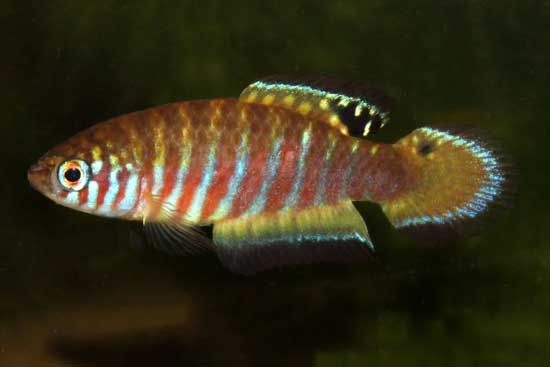
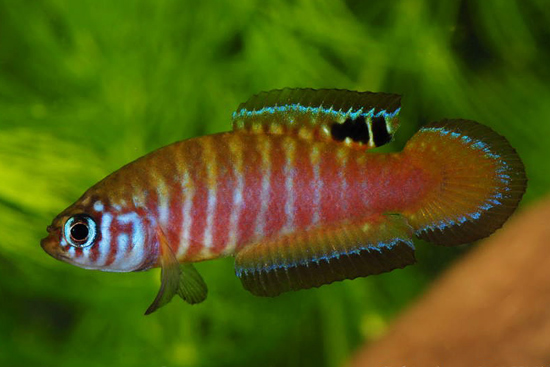
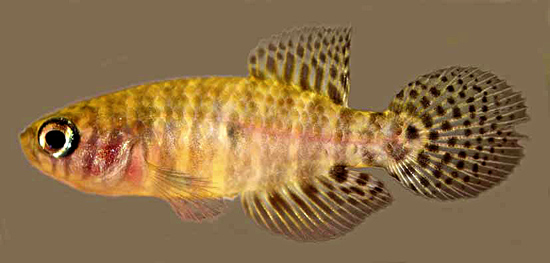
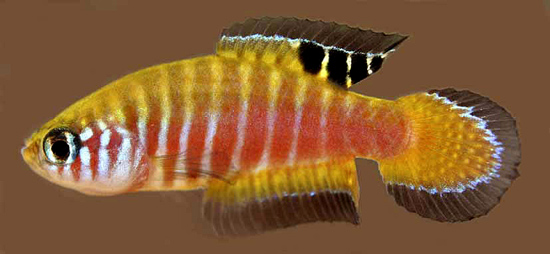
The species was collected near Simpsonichthys parallelus and Simpsonichthys cholopteryx and all are close related to each other. Simpsonichthys nigromaculatus is diagnosed from S. cholopteryx by fewer anal fin rays in female, narrower blue bars on flank in male, and absence of bars on fins and from S. parallelus by yellow dots on Caudal fin in male and deeper body in male.
Reproduction
The care and breeding of species of the genus Simpsonichthys is for advanced enthusiasts. Propagation is not the only thing that needs extra attention. First, it is not easy to purchase the species because these species are rarely offered. Simpsonichthys are fish that deposit their eggs piece by piece by diving deep into the substrate. They are moderately productive and their eggs generally have an incubation period of 2,5 to 3 months at a storage temperature of 25 to 28 C. However, it is advisable to check at an earlier date for eggs that develop before then. Experience of some breders has shown that eggs are ready to hatch even after 5 to 6 weeks. In some species the developed eggs are very dark in color and therefore it is difficult to see the iris inside the egghull and that makes it difficult to see what state the eggs are in.
Always try out just a few of the eggs before putting all the peat in the water. Such a test is necessary to recognize if the hatchlings will not remain belly sliders and thus will swim well.
It is best to use rainwater because Simpsonichthys is sensitive to calcium-rich water. The best temperature for watering is 18 to 20 degrees Celsius. The young are relatively large when they hatch because their eggs are also quite large. They can eat Artmia immediately after hatching and after a few weeks also much larger live foods such as sieved Daphnia. After 6 weeks the youngsters are already able to produce the first eggs. Their life expectancy in captivity can reach up to 1.5 years. But in nature they do not live long because their pool goes dry after 7 to 8 months.
Remarks:
A breeder I know indicated that breeding Simpsonichthys margaritatus benefited from floating plants above where they come to deposit. This can of course also be the case with the other species of the genus Simpsonichthys.
Variations
Map
Meristics
Max. size 4.5 cm.
Dorsal 16.0,
Anal 19.3,
D/A 3.5,
LL scale count (average)26.6
Pre- dorsal length to % SL – 56.8 %
Depth to % SL – 31.4 %
Literature
killifish genus Simpsonichthys
(Teleostei: Cyprinodontiformes: Aplocheiloidei: Rivulidae) Zootaxa 1669: 1–134.