 Spectrolebias bellidoi, |
History
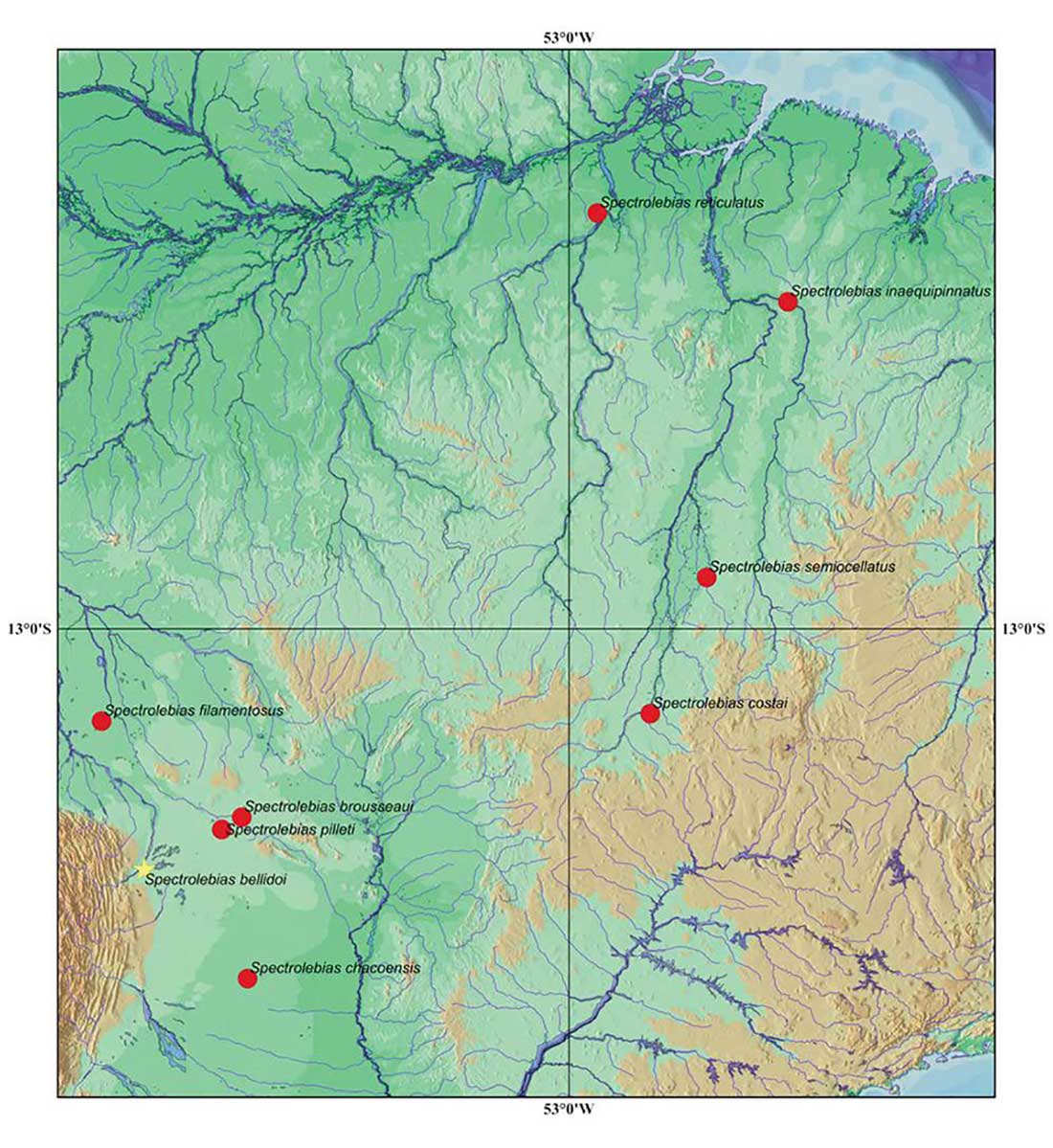
Spectrolebias bellidoi is described from a temporary pool from the upper reaches of the Río Grande, Río Mamoré basin, Departamento Santa Cruz, Bolivia. The new species is distinguished from all congeners by the unique shape of the anal fin of the female, which consists of two parts, a rounded anterior part, and a posterior part (from the 14th-15th ray), gradually decreasing in size (vs. entire anal fin with rounded outline) and a higher number of anal fin rays (30 vs. 21-28), in females. It can also be distinguished from all its congeners, except S. reticulatus and S. pilleti, by the location of the dorsal fin, which in males has its origin anterior to the origin of the anal fin.
Diagnosis: Spectrolebias bellidoi differs from the remaining representatives of the genus Spectrolebias by the presence of an unique light gray color pattern of male’s head and trunk anterior to the vertical line passing through the pelvic fin origin, followed by two narrow light turquoise-dark blue bars, posterior half of body dark blue with 3-4 rows of small white dots, which are also spread in the unpaired fins (vs. distinct color patterns present on the remaining species of Spectrolebias), vertebrae to anal fin origin (8-9 vs. 6-7 in S. reticulatus and in length), an unique pattern of black spots and vertical black stripes of varied shape and quantity on the flank (vs. a single black spot in S. filamentosus, S. chacoensis and S. brousseaui, no spots in S. inaequipinnatus, S. reticulatus, and S. semiocellatus, and a blue spot in S. pilleti), a lower head depth (73.2- 77.7% in HL vs. 78.1-101.8%), higher number of rays in anal fin (30 vs. 21-28), a higher number of rays in dorsal fin (21-26 vs. 13-21), origin of anal fin at the 13th vertebra (vs. 8th-10th in S. semiocellatus or 22th-24th in S. chacoensis), pelvic fin tip reaching base of 7th anal-fin rays (vs. 2nd-3rd in S. semiocellatus and S. filamentosus, or between the urogenital papillae and anal fin in S. costae).
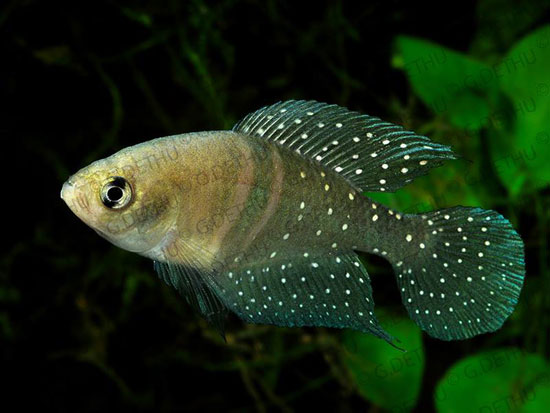
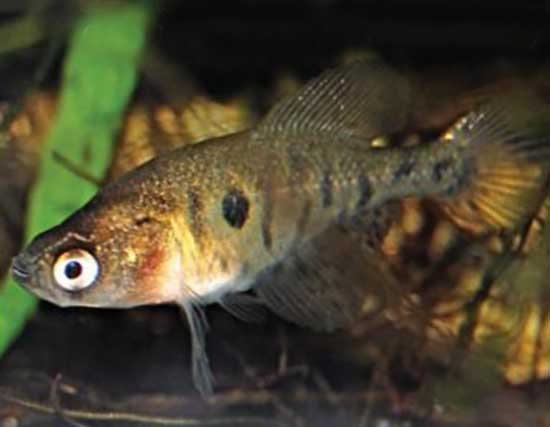
Additionally, Spectrolebias bellidoi can be distinguished from all congeners, except S. reticulatus and S. pilleti, by the position of the dorsal fin, which has its origin anterior to the origin of the anal fin in males (vs. origin of dorsal fin posterior to the anal fin in males), and from the remaining species of the genus, except S. chacoensis, by the number of pelvic-fin rays (7 vs. 5-6), and number of vertebrae, with exception of S. semiocellatus (31- 33 vs. 25-30).
From KilliData:
Etymology: in honor of Waldo Bellido Villavicencio (environmentalist), veterinarian in Santa Cruz de La Sierra Bolivia and second describer's friend.
The type locality of Spectrolebias bellidoi is a small annual pool (April, 2014) with a high density of specimens of the species and from other sympatric annual fishes like Austrolebias accorsii, Trigonectes aplocheiloides, Neofundulus sp., probably because rainy season is near its end ; temperature of water is 30°C and substratum consists of clay ; water is turbid with pH 6.5, and electric conductivity 120 ?S/cm ; aquatic vegetation is composed by Azolla sp. (Nielsen & Pillet, 2015a, b).
Reproduction
To breed these species one must be an experienced Killi enthusiast and especially the preservation of the eggs is a tricky issue. Also the breeding of the tiny youngsters when they are just out of the egg is a challenge and will only succeed with tiny food like Paramecium and micro nematodes. Only after a few weeks will the joung be able to eat newly hatched Artemia nauplii. It is not only a challenge to obtain the two species mentioned above but also to propagate them properly. The species within Spectrolebias have varying development times with large differences in the time it takes for the eggs to fully develop. But in general it takes longer than with many other species that deposit their eggs in the soil. It is therefore important to regularly check the peat in which the eggs are deposited and stored after a period of 3 months on their development status. This species group prefers to live in larger bodies of stagnant water that can be of temporary nature like swamps, flooded land and pools. They can be found in savannah- and forest like areas, mostly on a muddy bottom.
General behaviour is like that from most Spectrolebias species as they like to dwell in small groups and are not very active in there environment. Not fast swimming but more peacefull standing in shaded places. They eat, as most other annuals do, mosquito larves and small flying insects or crusteans.
After 6-8 weeks the fishes are capable to produce there first eggs if food was given sufficiently and water anges are implemented on a regular basis.
Remarks :
The species Spectrolebias bellidoi has not been distributed among Killi enthusiasts and I am going to try to collect this species at the type locality in 2022.
Variations
Map
Meristics
Max. size 4.5 cm.
Dorsal 24.0,
Anal 24.5,
D/A -1.0,
LL scale count (average) 27.5
Pre- dorsal length to % SL – 45.7 %
Depth to % SL – 34.0 %
Vertebrae count (average) 32
Literature
Nielsen, D.T.B. & Pillet, D. (2015): Spectrolebias bellidoi, a new annual fish (Cyprinodontiformes: Rivulidae: Cynolebiatinae) from the upper Río Grande basin, Amazon basin, Bolivia. aqua, International Journal of Ichthyology, 21 (4): 180–187.