 Spectrolebias brousseaui, |
History
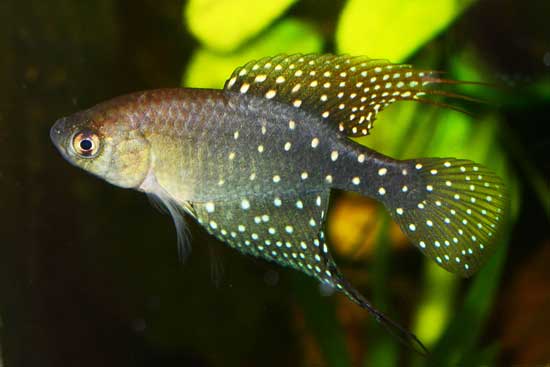
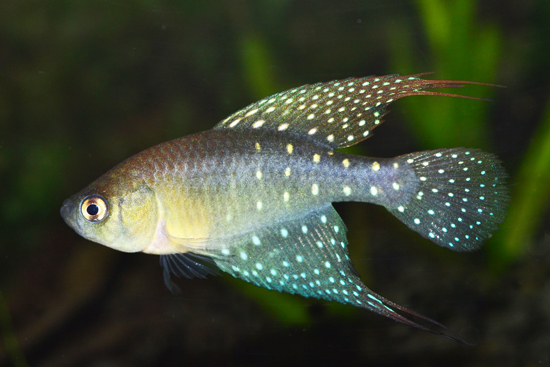
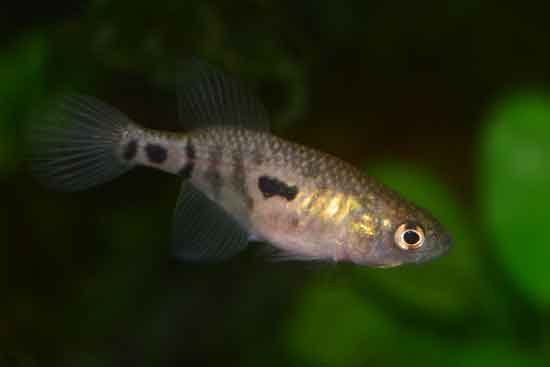
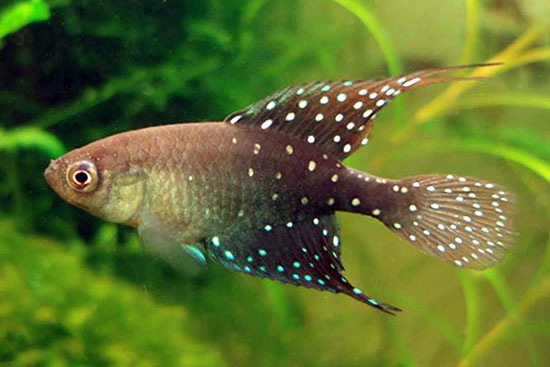
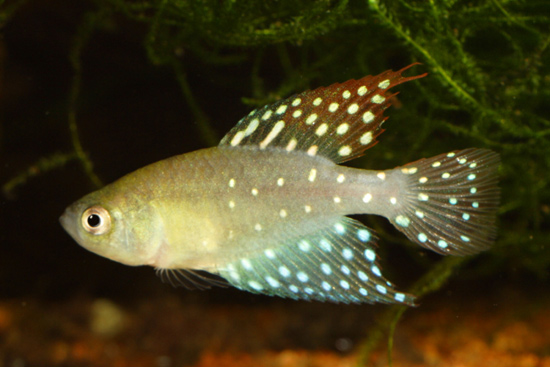
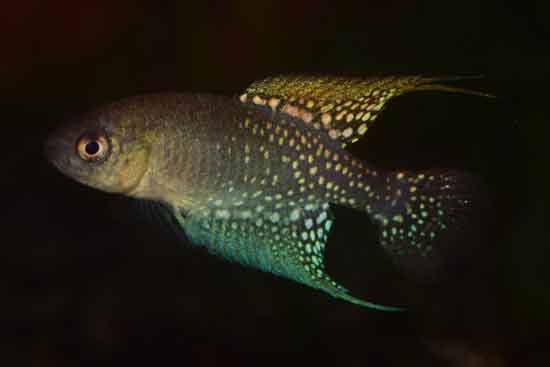
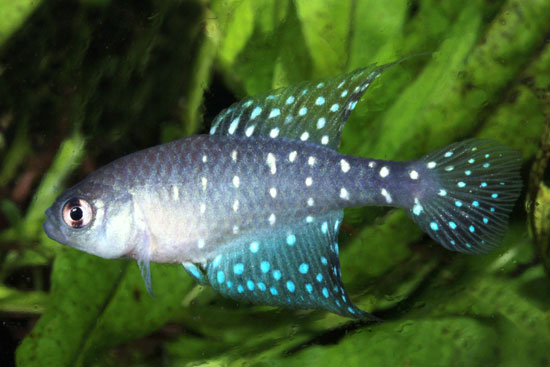
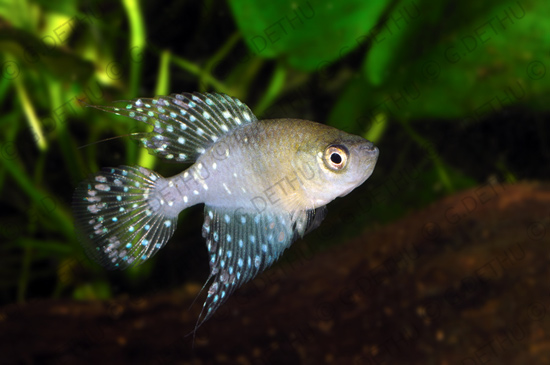
Spectrolebias brousseaui is described from a temporary pool from the upper río Mamoré basin, Departamento Santa Cruz, Bolivia. The new species is distinguished from all congeners, by the overall dark blue coloration on the posterior two-thirdsof body with bright blue iridescent spots vertically aligned in males. Spectrolebias brousseaui differs from all other species of the genus, except S. filamentosus, for having pelvic fins separated by a space (vs. pelvic fins in contact), long filaments at the tip of the dorsal and anal fins in males (vs. absence of filaments or presence only on dorsal fin in S. semiocellatus and S. inaequipinnatus, or the presence on the anal fin in S. chacoensis), and presence of contact organs on the scales of the flanks in males (vs. absence of contact organs on flanks in all remaining Spectrolebias species).
Reproduction
From Gerson Perceval, Brazil, I received the following info about breeding this species. He wrote:
We have obtained good spawns in groups of 3-5 individuals with couples or trios in aquariums of at least 18 liters. But these fishes can also be kept as single- or double trio in aquariums up to 12 liters.
The species is not an aggressive species, but the males chase females all the time, what can stress them - if kept as a pair only.
Spectrolebias brousseaui is an annual fishspecies that dives into the peat. You can use for that a pot or cover the whole bottom of the tank with peat...as long as the peat has a minimum of 5 cm. of depth. (here we use coconut powder). In the latter configuration seems to have less stress.
Water parameter are best with soft water and a pH of slightly acid to neutral between 6.5 and 7.0.
These fish seem to like very clean water and greatly appreciate the exchange of water, but one should be careful that there is not a parameter change very sharp because they tend to develop external parasitic diseases in these cases. Are especially sensitive to sudden temperature changes.
Temperature between 23 ° C and 25 ° C.
The court and spawning is frequent, but much eggs spoil.
The diapause lasts between 3 to 5 months in peat moisture and average mean temperature of 23 °.
Babies are born small and need adequate food in the first week (here we use microworms oats, branchonetas and paramecium), but grow quickly and in a week or slightly less are able to feed themselves with fresly hatched artemia nauplii.
The sex-ratio is relatively balanced, tending a little more for males in a ratio of approximately 60% x 40%.
Remarks :
Thank you very much Gerson for your contribution.
Variations
Map
Meristics
Max. size 0.0 cm.
Dorsal 00.0,
Anal 00.0,
D/A 0.0,
LL scale count (average) 00.0
Pre- dorsal length to % SL – 00.0 %
Depth to % SL – 00.0 %
Literature
Nielsen D.T.B. 2013. Spectrolebias brousseaui (Cyprinodontiformes: Rivulidae: Cynolebiatinae),a new annual fish from the upper río Mamoré basin, Bolivia. Neotropical Ichthyology, 11(1):81-84, Sociedade Brasileira de Ictiologia