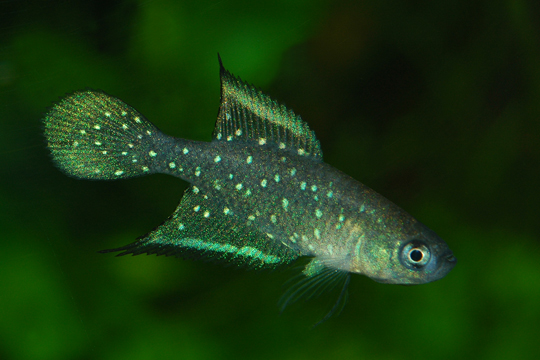
 Spectrolebias chacoensis, Spectrolebias chacoensis, |
History
Spectrolebias chacoensis was described by Armato as Simpsonichthys chacoensis from the Chaco plains in Paraguay and as aquarium fish introduced by Dutch aquarists (Vandenberg 1994) after a collecting expedition. Costa placed this species in the genus Spectrolebias in 2011.
Temporary waterbodies at Charca Topógrafo Acevedo, 14 km from radio command nº2 Americo Picco, 624 km nothwest of Asuncion towards Mariscal Estigarribbia, Nueva Ascunción, Paraguay.
Discovered on 20 August 1952 during the Expedition Estacion Biologia de Donana, Espana.
Replaced northerly by S. filamentosus, north- easterly by S. costai.
Is found together with Papiliolebias bitteri, Neofundulus ornatipinnis and Austrolebias monstrosus.
In Costa's revision(2006) of the genera Nematolebias and Simpsonichthys he devaluated the genus status of Spectrolebias to subgenus. In the same work he assigned 4 other species from the Simpsonichthys clan to this subgenus and since the end of 2011 Costa made Spectrolebias a genus again. These species in this genus are: Spectrolebias reticulatus, S. costai, S. chacoensis and S. filamentosus. Since September 2008 another species is added to this genus. This was Simpsonichthys inaequipinnatus.


Reproduction
To breed these species one must be an experienced Killi enthusiast and especially the preservation of the eggs is a tricky issue. Also the breeding of the tiny youngsters when they are just out of the egg is a challenge and will only succeed with tiny food like Paramecium and micro nematodes. Only after a few weeks will the joung be able to eat newly hatched Artemia nauplii. It is not only a challenge to obtain the two species mentioned above but also to propagate them properly. The species within Spectrolebias have varying development times with large differences in the time it takes for the eggs to fully develop. But in general it takes longer than with many other species that deposit their eggs in the soil. It is therefore important to regularly check the peat in which the eggs are deposited and stored after a period of 3 months on their development status.
This species group prefers to live in larger bodies of stagnant water that can be of temporary nature like swamps, flooded land and pools. They can be found in savannah- and forest like areas, mostly on a muddy bottom. General behaviour is like that from most Spectrolebias species as they like to dwell in small groups and are not very active in there environment. Not fast swimming but more peacefull standing in shaded places. They eat, as most other annuals do, mosquito larves and small flying insects or crusteans.
After 6-8 weeks the fishes are capable to produce there first eggs if various types of small living food was given sufficiently.
Remarks:
The firs breeding record was provided by J.W. Hoetmer from The Netherlands.
Variations
Map
Meristics
Max. size 5.0 cm.
Dorsal 20.4,
Anal 24.0,
D/A 5.3,
LL scale count (average)27.2
Pre- dorsal length to % SL – 50.7 %
Depth to % SL – 28.7 %
Literature
Armato, L.H. 1986. Seis Especies nuevas del Genero Cynolebias Stdr, 1876, de Uruguay y Paraguay (Cyprinodontiformes, Rivulidae). Com. Zool. Mus. Hist. Nat. Montevideo, 11 (162): 10. pl. 5 (fig.8), pl. 6 (fig.9).
Costa, W. J. E. M. 2010. Historical biogeography of cynolebiasine annual killifishes inferred from dispersal- vicariance analysis. Journal of Biogeography, 37: 1995-2004. (PDF) Right click to open in new window