 Spectrolebias filamentosus, |
History
This species is was placed in the genus Spectrolebias (Costa) but was originally described within the genus Simpsonichthys.
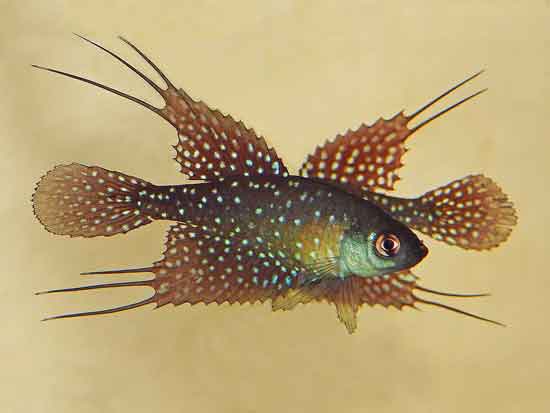
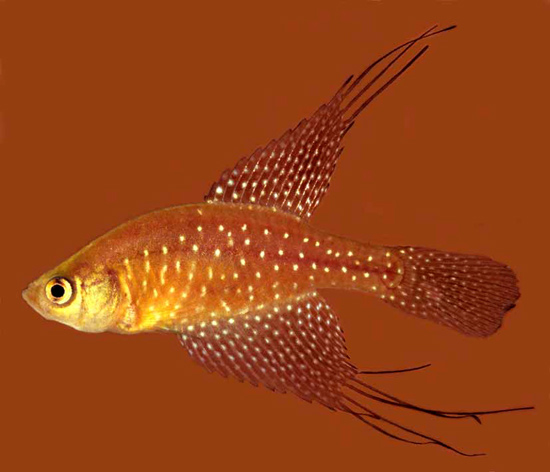
Diagnosis: longly extended posterior rays of Dorsal and Anal fins in male (extending beyond Caudal border), elongate Anal fin in female ; blue dots in male, vertically arranged on sides and along rays in unpaired fins ; female, with dark vertical bars on sides.
The name was given with reference to the filamentosus extencion in the male dorsal and anal fins.
Reproduction
To breed these species, one must be an experienced killifish enthusiast; storing the eggs, in particular, is a difficult task. Rearing the tiny fry, right after they hatch, is also a challenge and can only be done with very fine food such as Paramecium and micronematodes. Only after a few weeks can the fry eat newly hatched Artemia nauplii. It is not only a challenge to obtain the two species mentioned above, but also to breed them properly. The species within the genus Spectrolebias have varying development times, with significant differences in the time it takes for the eggs to fully develop. In general, however, it takes longer than for many other species that lay their eggs in the substrate. It is therefore important to regularly check the peat in which the eggs have been laid to monitor their developmental status.
This group of species prefers to live in larger bodies of standing water that may be temporary in nature, such as swamps, flooded land, and pools. They are found in savanna and forested areas, usually on muddy bottoms.
Their behavior is broadly similar to that of most Simpsonichthys species: they prefer to live in small groups and are not very active in their environment. They do not swim fast, but remain calm in shaded areas. Like most other annual fish, they feed on mosquito larvae, small flying insects, and crustaceans.
After 6–8 weeks, the fish are able to produce their first eggs, provided they have been fed a sufficiently varied diet of small live food.
Remarks:
I haven’t been able to get my hands on any eggs of this species. It’s gone completely wrong a few times because the eggs didn’t survive the trip to Aruba in good condition. I’m still looking for new specimens.
Once I’ve got the hang of this and have raised these beauties to adulthood, I hope to take some spectacular photos of them as well.
Variations
Map
Meristics
Max. size 4.5 cm.
Dorsal 17.2,
Anal 23.8,
D/A 6.5,
LL scale count (average)28.4
Pre- dorsal length to % SL – 50.7 %
Depth to % SL – 33.2 %
Literature