 Spectrolebias gracilis, |
History
The miniature seasonal killifish Spectrolebias costae , first described for the middle Araguaia River basin, has been also recorded from two areas in the middle Tocantins River basin, from where male specimens exhibit some differences in their colour pattern. Analyses directed to species delineation (GMYC and bPTP), using a fragment of the mitochondrial gene COI, strongly support two species, S.costae from the Araguaia River basin and a new species from the Tocantins River basin. Spectrolebias gracilis sp. n. is described on the basis of specimens collected from two localities separated by about 530 km, Canabrava River floodplains near Alvorada do Tocantins and Tocantins River floodplains near Palmeirante. Field inventories were unsuccessful in finding additional populations in the region, which is attributed to the high environmental degradation, including several large dams that have permanently inundated typical killifish habitats. Spectrolebias gracilis is member of a clade also including S. costae , S. inaequipinnatus , and S. semiocellatus, diagnosed by having the dorsal and anal fins in males with iridescent dots restricted to their basal portion, caudal fin in males hyaline, and caudal-fin base with two pairs of neuromasts. Within this clade, a single miniaturisation event is supported for the most recent common ancestor of the subclade comprising S. costae and S. gracilis , which differ from other congeners by reaching only about 20 mm standard length as maximum adult size.
Introduction
The great species diversity, striking colour patterns and the broad array of unique biological specializations make aplocheiloid killifishes important members of the tropical biota of Americas, Africa, and southern Asia (Costa 2008). The subequatorial South American area comprising the largest southern tributaries of the Amazonas River (Tocantins, Araguaia, Xingu and Tapajós River drainages), is remarkable by concentrating numerous endemic aplocheiloid fishes (Costa 1990, 2007a, b, 2011, 2016), many of them consisting of miniatures not surpassing 30 mm of standard length (SL) when adults (Costa 1998). Some endemic groups, such as the genera Maratecoara Costa, 1995, Pituna Costa, 1989, Plesiolebias Costa, 1989, and part of the genus Spectrolebias Costa & Nielsen, 1997 are members of the aplocheiloid clades known as seasonal or annual killifishes (Myers 1942; Costa 2002a), that comprise species completing their whole life cycle in seasonal pools formed during the rainy seasons.
Spectrolebias is the most basal lineage and the only genus of the seasonal killifish tribe Cynolebiini that is geographically widespread along southern Amazon tributaries (Costa 2007a; Costa et al. 2017). Spectrolebias costae (Baker 1990) is the smallest member of the Cynolebiini, with its maximum adult size not surpassing about 20 mm SL (Costa 2007a). This species was first discovered in the early 1980’s, near the central Brazilian town of Aruanã, in the middle Araguaia River floodplains, by local fishermen (L. Costa, pers. comm. to WJEMC, January 1986; Costa 2002b). It was soon exported as an aquarium fish species and quickly became a worldwide popular species, but its formal description was only published about ten years later, in an American aquarium association journal (Lazara 1991). It was then named Cynolebias costai Lazara, 1991, in honour of the Brazilian fisherman L. C. Costa from Aruanã. However, one year before Lazara’s description, Baker (1990) reported his experience with this species in aquarium referring to it as Cynolebias costae and providing a brief description of the colour pattern of males and females. Therefore, following the International Code of Zoological Nomenclature (ICZN 1999), Baker (1990) should be considered the author of C. costae, of which Cynolebias costai Lazara, 1991 is the junior synonym (Costa 2008). More recently, this species was transferred to Spectrolebias (Costa 2010).

Between 1986 and 1994, in addition to the type locality region around Aruanã, S. costae was also found in other localities of the Araguaia River basin in the Bananal Island and adjacent areas in the Formoso River basin, as well as in the das Mortes River floodplains, which is a main tributary of the Araguaia River (Costa 1995b). However, some years later new populations morphologically similar to S. costae were found in the middle section of the Tocantins River basin (Costa 2007a). More detailed comparison revealed that populations from the Tocantins basin differ from populations from the Araguaia basin in some characters of the male colour pattern, suggesting that it might be a distinct cryptic species (sensu Bickford et al. 2007). That hypothesis is herein corroborated by mitochondrial-DNA species delimitation analyses, and so we provide a formal description of this new species.
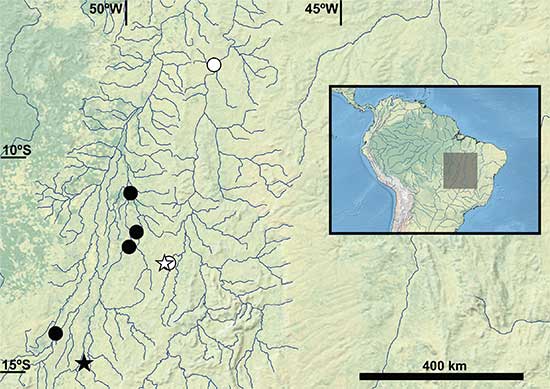
Field studies failed to find specimens of S. costae in the type locality region or in the das Mortes River basin, areas that were drastically modified in recent years (see Discussion). Consequently, for molecular studies, field collections were made only in the floodplains of the Formoso River, middle Araguaia River basin, where populations of S. costae are still abundant, and in two localities of the middle Tocantins River, in the Canabrava River floodplains and in the Tocantins River floodplains near the town of Palmeirante. For morphology, both recent and older collections deposited in the ichthyological collection of the Institute of Biology, Universidade Federal Rural do Rio de Janeiro (UFRJ), were analysed. Specimens were captured with small dip nets (40 × 30 cm) and euthanized soon after collection. Euthanasia was conducted in a buffered solution of tricaine methanesulfonate (MS-222) at a concentration of 250 mg/l, for a period of about 10 minutes, i.e., until opercular movements ceased.
Spectrolebias gracilis is member of a clade endemic to the Araguaia-Tocantins River System, also including S. costae, S. semiocellatus Costa & Nielsen, 1997 and S. inaequipinnatus Costa & Brasil, 2008, and morphologically diagnosed by: dorsal and anal fins in males with iridescent dots restricted to the basal portion of fins (vs. scattered over the whole fin), caudal fin in males hyaline (vs. variably coloured, usually dark red or grey), caudal-fin base with two pairs of neuromasts (vs. one). Spectrolebias gracilis is similar to S. costae and distinguished from S. semiocellatus and S. inaequipinnatus by having dorsal fin rounded in males (vs. pointed), dark brown to black pigmentation on the flank in males (vs. light brownish grey), and a subdistal bright blue stripe on the dorsal and anal fins in males (vs. subdistal bright blue absent). Spectrolebias gracilis differs from S. costae by the iridescent light blue colour pattern in males, comprising the presence of 10–12 small blue spots irregularly arranged on opercle, surrounded by diffuse blue iridescence (Fig. 4; vs. 6–8 small blue spots, usually arranged in three vertical series, contrasting with dark brown colour ground, Fig. 3) and one or two series of dots irregularly arranged on the basal portion of the dorsal fin (Fig. 4; vs. blue dots arranged in single longitudinal row close to fin base,
Reproduction
To breed these species one must be an experienced Killi enthusiast and especially the preservation of the eggs is a tricky issue. Also the breeding of the tiny youngsters when they are just out of the egg is a challenge and will only succeed with tiny food like Paramecium and micro nematodes. Only after a few weeks will the joung be able to eat newly hatched Artemia nauplii. It is not only a challenge to obtain the two species mentioned above but also to propagate them properly. The species within Spectrolebias have varying development times with large differences in the time it takes for the eggs to fully develop. But in general it takes longer than with many other species that deposit their eggs in the soil. It is therefore important to regularly check the peat in which the eggs are deposited and stored after a period of 3 months on their development status.
This species group prefers to live in larger bodies of stagnant water that can be of temporary nature like swamps, flooded land and pools. They can be found in savannah- and forest like areas, mostly on a muddy bottom.
General behaviour is like that from most Spectrolebias species as they like to dwell in small groups and are not very active in there environment. Not fast swimming but more peacefull standing in shaded places. They eat, as most other annuals do, mosquito larves and small flying insects or crusteans.
After 6-8 weeks the fishes are capable to produce there first eggs if various types of small living food was given sufficiently and water was canged on a regular basis.
Remarks:
Variations
Map
Meristics
| Holotype | Paratypes | ||
| male | males (10) | females (6) | |
| Standard length (mm) | 19.2 | 17.3–20.8 | 16.1–17.8 |
| Percent of standard length | |||
| Body depth | 33.6 | 31.3–36.7 | 32.1–33.6 |
| Caudal peduncle depth | 14.2 | 13.2–15.7 | 12.9–13.7 |
| Pre-dorsal length | 50.6 | 46.8–51.2 | 56.4–61.8 |
| Pre-pelvic length | 43.7 | 39.6–45.6 | 45.3–47.9 |
| Length of dorsal-fin base | 36.8 | 36.3–40.9 | 21.1–26.4 |
| Length of anal-fin base | 43.9 | 39.6–44.2 | 26.7–30.3 |
| Caudal-fin length | 35.7 | 33.8–38.1 | 33.0–37.1 |
| Pectoral-fin length | 24.8 | 21.6–24.8 | 19.0–21.3 |
| Pelvic-fin length | 11.1 | 9.8–11.7 | 9.9–11.8 |
| Head length | 30.5 | 29.8–33.7 | 31.7–33.5 |
| Percent of head length | |||
| Head depth | 95.6 | 94.4–103.3 | 84.7–93.3 |
| Head width | 58.6 | 55.7–62.8 | 56.5–60.7 |
| Snout length | 12.1 | 11.9–14.9 | 9.4–13.4 |
| Lower jaw length | 17.4 | 15.2–19.2 | 14.8–17.2 |
| Eye diameter | 38.5 | 35.1–39.6 | 35.9–39.7 |