 Spectrolebias inaequipinnatus, |
History
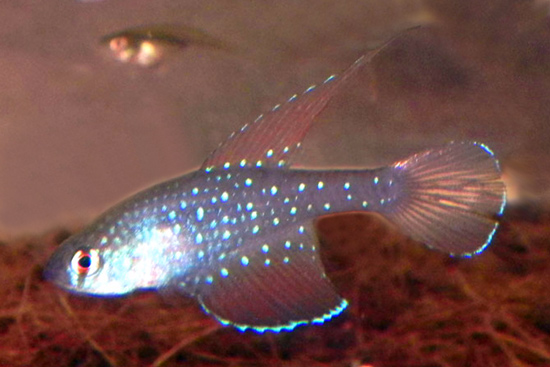
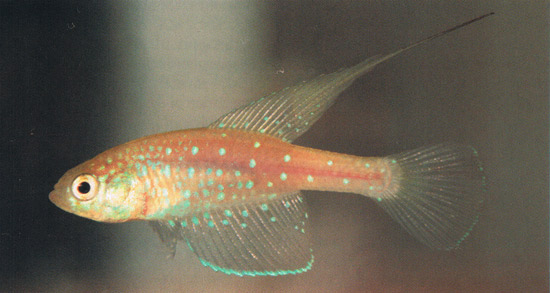
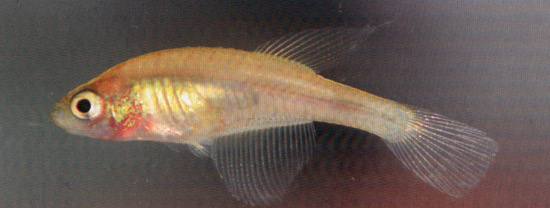
Simpsonichthys inaequipinnatus, new species, from the Tocantins River basin, central Brazil, is described. It is considered closely related to S. semiocellatus from the Araguaia River basin with which it shares two derived features: dorsal fin subtriangular in males, terminating as a single, long filament, and frontal squamation F-patterned. It differs from S. semiocellatus by possessing more dorsal-fin rays in males, longer dorsal-fin filament, more neuromasts in the infraorbital series, and by the absence of a black spot with blue margin on the anal fin in males.
Note: The genus Spectrolebias was erected for a single species with the name Spectrolebias semiocellatus, by W. Costa & Nielsen in 1997.
In Costa's revision (2006) of the genera Nematolebias and Simpsonichthys he devaluated the genus status of Spectrolebias to subgenus. In the same work he assigned 4 other species from the Simpsonichthys clan to this subgenus. These species are: S. reticulatus, S. costai, S. chacoensis and S. filamentosus. Since September 2008 Simpsonichthys inaequipinnatusis was added to this subgenus that became again the staus of genus in 2011 (Costa 2011).
Reproduction
From Gerson Perceval, Brazil, I received the following info about breeding this species. He wrote:
We have obtained good spawns in groups of 3-5 individuals with couples or trios in aquariums of at least 18 liters. But these fishes can also be kept as single- or double trio in aquariums up to 12 liters.
The species is not an aggressive species, but the males chase females all the time, what can stress them - if kept as a pair only.
Spectrolebias inaequipinnatus is an annual fishspecies that dives into the peat. You can use for that a pot or cover the whole bottom of the tank with peat...as long as the peat has a minimum of 5 cm. of depth. (here we use coconut powder). In the latter configuration seems to have less stress.
Water parameter are best with soft water and a pH of slightly acid to neutral between 6.5 and 7.0.
These fish seem to like very clean water and greatly appreciate the exchange of water, but one should be careful that there is not a parameter change very sharp because they tend to develop external parasitic diseases in these cases. Are especially sensitive to sudden temperature changes.
Temperature between 23 ° C and 25 ° C.
The court and spawning is frequent, but much eggs spoil.
The diapause lasts between 3 to 5 months in peat moisture and average mean temperature of 23 °.
Babies are born small and need adequate food in the first week (here we use microworms oats, branchonetas and paramecium), but grow quickly and in a week or slightly less are able to feed themselves with fresly hatched artemia nauplii.
The sex-ratio is relatively balanced, tending a little more for males in a ratio of approximately 60% x 40%.
Remarks :
Thank you Gerson for your contribution.
Variations
Map
Meristics
Max. size 0.0 cm.
Dorsal 00.0,
Anal 00.0,
D/A 0.0,
LL scale count (average) 00.0
Pre- dorsal length to % SL – 00.0 %
Depth to % SL – 00.0 %
Literature
Costa, W.J. E. M. & Gilberto C. Brasil.
Simpsonichthys inaequipinnatus, a new seasonal killifish from the Tocantins River basin, Brazil (Cyprinodontiformes: Rivulidae). Ichthyol. Explor. Freshwaters, Vol. 19, No. 3, pp. 245-248, 2 figs., 1 tab., September 2008.
Costa, W. J. E. M. 2010. Historical biogeography of
cynolebiasine annual killifishes inferred from dispersal-
vicariance analysis. Journal of Biogeography,
37: 1995-2004. (PDF) Right click to open in new window