 Spectrolebias pilleti, |
History
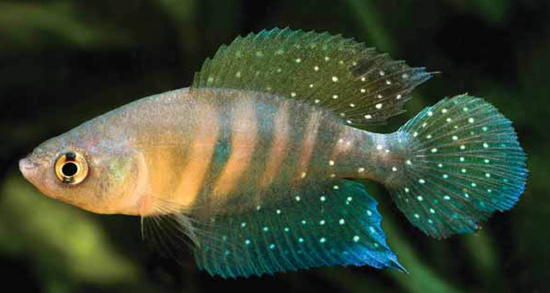
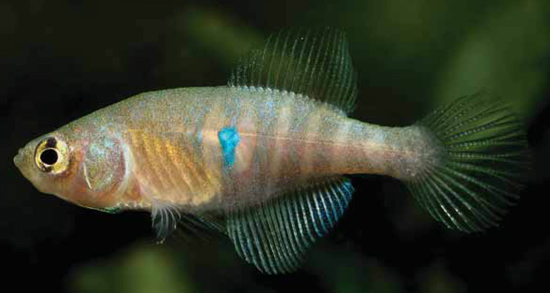
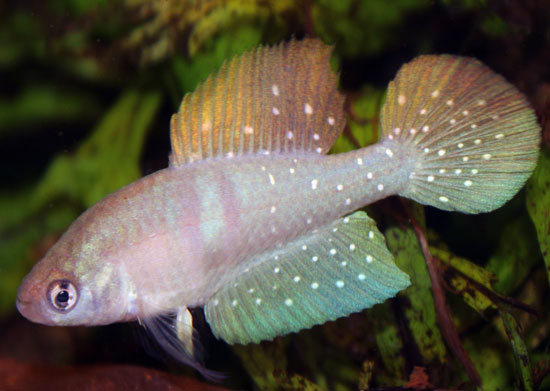
Spectrolebias pilleti n. sp. is described from a temporary pool from the upper rio Mamoré basin, Departamento Santa Cruz, Quimone city, Bolivia. The new species is distinguished from all congeners by the unique color pattern of males: 3 to 5 vertical blue bars alternating with a light reddish brown background in males (vs. absence of bars), by the presence of an iridescent blue spot on the flank in female (vs. presence of one or more black spots), by the absence of filaments at the tips of dorsal fin and anal fin in males, except Spectrolebias reticulatus (vs. long filaments on dorsal and anal fins in S. brousseaui and S. filamentosus, filaments on the dorsal fins of S. semiocellatus and S. inaequipinnatus, or filaments in the anal fins of S. chacoensis) and by the presence of scales covering the base of anal fin in males (vs. absence of these scales in the remaining congeners). Also distinguished from all congeners, with the exception of S. reticulatus, by the position of the dorsal fin, which has its origin anterior to the origin of the anal fin in males.
Holotype: Deposited at Museo Noel Kempff,
Santa Cruz de La Sierra, Bolivia. (MNKP-11153)
male 28.9 mm SL: Bolivia, Departamento Santa
Cruz, Quimone city, 45.40 km west of San José
dos Chiquitos, temporary pool near the río Quimone,
the río San Pablo basin, (17°42’48.1”S
61°08’56.1”W), altitude 263 m, 26 February
2012, Didier Pillet, Jean Marc Beltramon, Michel
Beuchey & Christine Lambert.
Reproduction
To breed these species one must be an experienced Killi enthusiast and especially the preservation of the eggs is a tricky issue. Also the breeding of the tiny youngsters when they are just out of the egg is a challenge and will only succeed with tiny food like Paramecium and micro nematodes. Only after a few weeks will the joung be able to eat newly hatched Artemia nauplii. It is not only a challenge to obtain the two species mentioned above but also to propagate them properly. The species within Spectrolebias have varying development times with large differences in the time it takes for the eggs to fully develop. But in general it takes longer than with many other species that deposit their eggs in the soil. It is therefore important to regularly check the peat in which the eggs are deposited and stored after a period of 3 months on their development status.
This species group prefers to live in larger bodies of stagnant water that can be of temporary nature like swamps, flooded land and pools. They can be found in savannah- and forest like areas, mostly on a muddy bottom.
General behaviour is like that from most Spectrolebias species as they like to dwell in small groups and are not very active in there environment. Not fast swimming but more peacefull standing in shaded places. They eat, as most other annuals do, mosquito larves and small flying insects or crusteans.
After 6-8 weeks the fishes are capable to produce their first eggs if various types of small living food was given sufficiently and water was kept in optimal conditions.
Remarks:
Variations
Map
Meristics
Max. size 0.0 cm.
Dorsal 00.0,
Anal 00.0,
D/A 0.0,
LL scale count (average) 00.0
Pre- dorsal length to % SL – 00.0 %
Depth to % SL – 00.0 %
Literature
Nielsen D.T.B., R.D. Brousseau, 2013
Spectrolebias pilleti, a new annual Killifish (Cyprinodontiformes: Rivulidae: Cynolebiatinae) from the upper río Mamoré basin, Bolivia.
Aqua, Journal of Ichthyology and Aquatic Biology, 19 (3): 115-122, figs.